Dialogue with Outside Directors
July 2026
The Boardʼs Role in Realizing Aspiration 2035
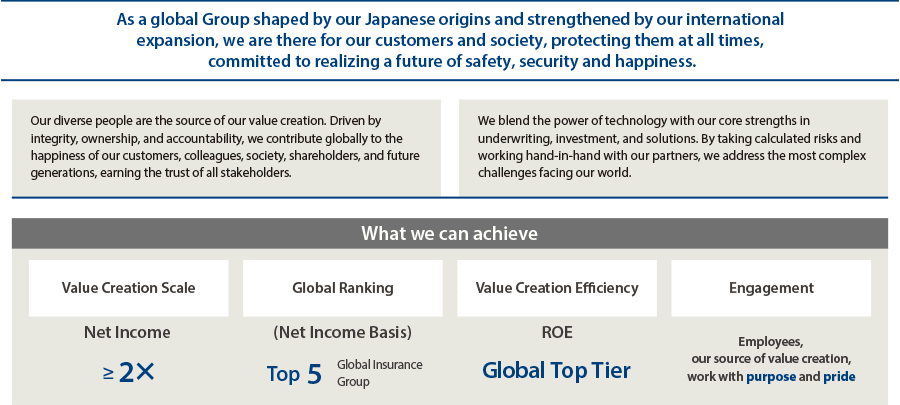
Aspiration 2035 sets out what the Tokio Marine Group aspires to be 10 years from now.
How did the Board help shape it, and what role will it play in turning that aspiration into reality?
We spoke with Directors Katanozaka and Osono.
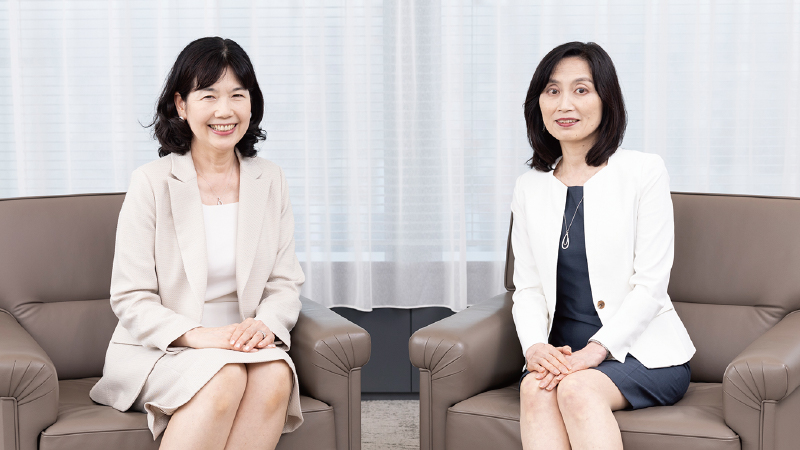
Shinya Katanozaka (Left)
Outside Director
Emi Osono (Right)
Outside Director
Turning Aspiration 2035 into a Guide to Action for Every Employee
- Secretariat
- In May 2026, the Company announced Aspiration 2035, its vision for what the Group aims to be in 2035. What did the Board discuss as it was being developed?
- Osono
- Outside directors are often expected to keep management in check - to apply the brakes from a risk and governance perspective. I do not question the importance of that role. But if a company is to grow sustainably, I believe outside directors also need to ask management what it is aiming for and where it is heading, and to encourage it to take on new challenges.
In developing Aspiration 2035, I thought it was highly significant that CEO Koike did not start with numerical targets or business strategy. He started by asking, "What kind of company do we want to be in 2035?" - Katanozaka
- I agree. The process itself was very meaningful. Management was not the only group involved; mid-career and younger employees also joined the discussion, starting with the question of what kind of company we want to be. The Board then refined the vision from a range of perspectives, including those of outside directors. First we built a shared understanding of the qualitative aspiration, and only then translated it into numbers and strategy. I think that sequence has become a good way of working for Tokio Marine, carried forward from the current Mid-Term Business Plan.
Aspiration 2035 cannot end with its announcement. The real question is whether each employee can connect their own aspirations to the strategy and concrete actions of their business. The Board kept asking whether that connection would actually work in practice. - Osono
- I agree. What struck me most about the discussions among mid-career and younger employees was that they were not centered on questions like, "How much should we grow this business?" They were centered on, "What kind of company do we want to be?" and "How do I want to contribute to making that a reality?" They wanted Tokio Marine not only to compensate financial losses after accidents and disasters, but also to help prevent accidents and create greater security and new value. They talked about wanting to create new products and services, deliver more value to customers, and play an active role globally. I felt that one of the greatest values of Aspiration 2035 was the way that sense of initiative gave the employees involved a stronger sense of fulfillment and a greater desire to take on challenges. I hope that spirit spreads even further throughout the organization.
- Katanozaka
- Profit, ROE and other numbers are of course important. But what matters is the sequence of value creation - the process itself. It starts with the initiative and actions of each employee. Those actions deliver value to customers and society, and that value ultimately translates into profit and corporate value. If the numbers start to take on a life of their own, we lose sight of why we are pursuing growth in the first place.
The Board also discussed how, precisely because the targets are ambitious, we need to put the thinking behind them into words and convey the qualitative message with conviction.
One comment from an outside director that has stayed with me is that Aspiration should not be something management finishes and hands down to employees. It should be something each employee makes their own and continues to shape after it is announced. The Board focused on whether Aspiration, the strategy for getting there, and the quantitative targets were all connected by a clear line of logic - and whether the value creation process could actually work in practice. The role of outside directors is not to dampen management's ambition or willingness to take on challenges in pursuing Aspiration 2035. It is to keep asking whether the vision is being communicated with passion, whether it resonates with employees, and whether it inspires them to take ownership and act. That is how we can help make Aspiration 2035 more achievable.
Aspiration 2035: Our future vision
Evolving Our Business Model to Expand the Value We Create
- Secretariat
- Another major theme of Aspiration 2035 is to combine insurance with solutions and extend the value the Company provides beyond compensation after an accident or disaster - to prevention beforehand and recovery afterward. In other words, through "Insurance + Solutions," the Company aims to evolve its business model and expand the overall value it creates. How did the Board view this direction?
- Katanozaka
- Our Purpose has always been to be there for customers in times of need. Going forward, through the solutions business, our ambition is to be there for customers not only in times of need, but every day - working with them before accidents or disasters occur and continuing to support them afterward. The Board strongly supports this direction. As risks grow larger and more complex, we see this as a natural evolution of the Purpose Tokio Marine has carried forward since its founding - one that brings that Purpose to life in ways that address the challenges of our time and enables us to contribute more broadly to society.
That idea of being there "every day" actually takes me back to my time as President of ANA. At entrance ceremonies, I often told new employees, "Never forget about safety - even on your days off." For an airline, safety is not something you think about only after an accident. You have to stay alert to risk in everyday life and prevent accidents before they happen. Even when you are walking around town on a day off, you may suddenly notice a potential hazard. The idea is for that awareness to become second nature. I think the same is true of what an insurance company means by being there "every day." Each employee needs to keep an eye on customers' risks and social challenges in daily life and keep asking, "Is there more we can do?" I believe it is the accumulation of that awareness and action, person by person, that forms the foundation of the solutions business. - Osono
- The solutions business is something I care deeply about, too. When I served as an Audit & Supervisory Board Member at Tokio Marine & Nichido, I once received a report on a major fire. At the time, we were recognized for paying claims promptly. Of course that matters.
But I remember saying that what customers really want, above all, is for accidents not to happen in the first place. That concern was not mine alone; many officers and employees already shared it. Over time, Tokio Marine built on that thinking - launching the CORE disaster prevention consortium in 2021, acquiring ID&E in 2025, and developing other initiatives - and today those efforts have taken shape as the solutions business. It is now clearly positioned in our strategy as a third business alongside domestic and international insurance. As an outside director, I find it very encouraging to see a concern that so many employees have carried for years take concrete form as a business. - Katanozaka
- I completely agree. The solutions business did not appear overnight. It grew out of years of dialogue between employees who wanted to prevent accidents and disasters before they happen and experts across a wide range of fields, including disaster prevention and mitigation. Aspiration 2035 is a natural extension of those longstanding efforts.
- Osono
- And the next step is to translate that direction into what people actually do on the front line. Rather than optimizing separately within product, sales and claims, we need to start with the risks customers face and design insurance and solutions as one integrated offering. Our organization will need to evolve to support that as well.
- Katanozaka
- There are also limits to how far we can expandthe value we provide on our own. Take Build Back Better.
It is a compelling idea, but the reality is not simple. In the Noto Peninsula and Atami, recovery and reconstruction after disasters have taken years. Simply restoring communities to where they were is difficult enough; rebuilding them to be stronger than before is harder still. No insurance company can do that alone. We need to bring together a wide range of expertise and tackle the challenge across society.
Collaboration with external partners and M&A are important tools. But the point is not the collaboration or the M&A itself - it is the value they allow us to create. The Board therefore needs to judge whether each initiative will genuinely strengthen Tokio Marine's capabilities and expand the overall value we create. - Osono
- That connects with what we were just discussing.
When I think about how to expand the overall value we create, I do not see it as a question for the solutions business alone. It matters for the business portfolio as a whole. Through overseas M&A, Tokio Marine has built a globally diversified portfolio. But the goal has never been simply to broaden the scope of the business or diversify risk. We have also sought to connect the strengths of individual businesses and create greater value across the Group. One example is taking successful digitalization initiatives developed in Brazil and applying them to auto insurance in Asia. By connecting strengths across businesses and creating synergies in this way, we have enhanced the Group's overall competitiveness beyond the diversification benefits of a global portfolio. I believe that continuing to build those synergies will open up even greater possibilities for value creation.
How AI Is Reshaping Competition and Competitive Advantage
- Secretariat
- AI is impossible to ignore when considering what the Group will look like 10 years from now. How has the Board been discussing the relationship between AI and the management of the Company?
- Osono
- Management and the outside directors shared the view that AI is more than a tool for operational efficiency. It could transform customer touchpoints, distribution, products and services, underwriting, claims handling, and even revenue models. But AI itself does not create competitive advantage. Our edge comes from the distinctive expertise and data Tokio Marine has built through underwriting, claims handling and customer relationships. AI is a means of turning that expertise and data into new value.
If we are not careful, however, AI naturally gets pulled toward efficiency. The benefits are easy to see, and efficiency addresses immediate challenges, so it tends to come first.
But efficiency alone will not create value that is distinctly Tokio Marine. That is why we, as outside directors, pushed management not to postpone using AI to create customer value and to start turning data into value as early as possible.
The earlier we start experimenting, learning and adjusting, the better we become at organizing and using data - and at building the capabilities needed to deliver that value to customers. I believe it is that accumulation of learning that will ultimately create value unique to Tokio Marine. - Katanozaka
- Looking ahead, we may reach a world where AI agents choose insurance companies and products on behalf of customers. Then the question is simple: will Tokio Marine be selected automatically based on price alone, or chosen for the distinctive value we offer? Of course we need to bring in the best external technology. But we also need to be clear about how AI will strengthen Tokio Marine's competitive advantages and what data we need to make that happen. We have expertise in underwriting and claims, deep customer relationships, and the ability to deliver solutions grounded in real-world needs. The key is to combine those strengths with AI and turn them into distinctive value that gives customers a reason to choose Tokio Marine beyond price.
- Osono
- You can see that value in early detection as well. If AI can detect early signs of accidents or fraud and enable us to act before they happen, we can take the idea of being there "every day" a step further. That applies to underwriting and compliance as well: how can we use AI to predict problems and intervene early? The question is not how many tools we deploy. It is how deeply we embed AI in our business model and turn it into customer value and competitive advantage.
- Katanozaka
- Frankly, one thing I have noticed about Tokio Marine is how deeply the culture of careful deliberation is rooted. That is a real strength. But with AI, the same thoroughness can become a weakness. If we wait until we have assessed everything before acting, we will be too late. I have told management that in AI we should be willing to move at a pace that may even feel a little too fast: try, learn, adjust. Pushing management to move quickly from experimentation to implementation is also part of the role of outside directors.
- Osono
- I agree. Each business needs to learn by doing and evolve its use of AI as it goes. But keeping those lessons inside individual Group companies would be a waste. We need to share strong initiatives and insights across the Group and apply them more widely. The Global AI-HUB, established in 2025, is central to achieving that speed and sharing learning across the Group. It brings together the challenges and insights of each business so businesses can support one another across technology, talent and data. The goal is not for every company to pursue AI on its own, but to share results and learning and accelerate transformation across the Group.
I want to see that translate into business transformation with both speed and scale.
Achieving a High-Level Balance Between Growth and Governance
- Secretariat
- In June 2026, the Company transitioned to a Company with an Audit and Supervisory Committee. What is the Company seeking to achieve through this change in governance structure?
- Katanozaka
- Put simply, our aim is to achieve a higher-level balance between growth and governance. The Board has long had open and candid discussions, and effective oversight informed by a diverse range of perspectives has worked well.
We are not changing the structure because the previous framework was not working. We are changing it because the environment has changed and because we want to build on the governance framework we have developed and take it further. That is what I mean by achieving a higher-level balance. - Osono
- If I had to sum up why now, I would point to three things. First, the Board needs to deepen its discussions on strategy with medium- to long-term changes in the business environment in mind. Second, we need to delegate more authority to management so day-to-day decisions can be made faster. Third, we need to further strengthen governance in light of recent misconduct. Those three needs became more pressing at the same time, which is why we decided to review the governance structure now. We did not start with a preferred structure. For more than a year, we had frank and in-depth discussions about the pros and cons of three options: retaining the existing structure, becoming a Company with Audit and Supervisory Committee, or becoming a Company with Three Committees. Throughout those discussions, we outside directors consistently said that if more authority is delegated to management, the Board must in turn focus even more sharply on medium- to long-term direction and strategy, and align thoroughly with management on that direction.
From a governance perspective, one issue I cared particularly about was how to carry forward the function of the full-time Audit & Supervisory Board Members. They understood the Company's history and how work actually gets done, yet maintained their independence and spoke very candidly to the CEO when necessary. I had seen that firsthand, so I was genuinely concerned about whether we could preserve that function under the new structure.
Under the new Audit and Supervisory Committee, outside directors make up a majority, and an outside director serves as chair. At the same time, having Audit and Supervisory Committee Members with internal experience and a strong understanding of the business means they can "translate" the realities within the Company - and the context behind why things are the way they are - in a way outside directors can understand. In other words, we can combine an insider's understanding of the business with the objective perspective of outside directors. I supported the transition because I believe this structure can preserve the important functions previously performed by the fulltime Audit & Supervisory Board Members while using the strengths of the new model to make governance even more effective.
The Board also has a responsibility to systematically develop future CEO candidates and choose the best person to lead the Company. From that perspective, too, I believe this change in governance structure is significant. We have long used the voluntary Nomination Committee to consider succession from both internal and outside perspectives, with the Board ultimately selecting the CEO by consensus. Under the previous structure, Audit & Supervisory Board Members did not participate directly in Board decisions on nomination and compensation. Audit and Supervisory Committee Members, by contrast, are directors with voting rights and take part directly in those deliberations and decisions. That means the perspectives of oversight and audit can now be reflected more directly in CEO selection and compensation - matters at the very heart of management. - Katanozaka
- When choosing a CEO, the skills matrix is also important. The Nomination Committee discusses what knowledge and expertise the CEO should personally have, but we need to work backward from the management challenges the Company is likely to face in the future and think about both what the individual CEO needs to bring and what capabilities the Board as a whole needs to have. Whatever governance structure we adopt, what ultimately matters is making full use of the Board's diversity and collective expertise. The Board's role is to challenge assumptions that management may not see on its own, bring in the perspectives of society and the capital markets, and put alternative options on the table where appropriate. Sometimes that means raising difficult points to improve the quality of decision-making. To realize a long-term vision such as Aspiration 2035, we need to translate it into concrete strategy and action and keep testing whether they are working. As the environment changes, the assumptions behind the strategy will change as well. The Board therefore needs to keep asking: Are the assumptions and direction still valid? Do we have a genuine range of options? Are we maintaining the profitability and financial soundness we need?
The Board is also more effective when management shares points of disagreement and issues it is still wrestling with before reaching a conclusion. - Osono
- We are partners in trying to make the Company better. That is why I think management should share not only good news, but also challenges, concerns and uncertainties - and do so early. Only with that kind of openness can the Board get to the heart of the issues and contribute to better decisions. The Board also needs to use its limited time well, focusing on matters that genuinely warrant strategic discussion rather than spending time on explanations or confirming materials. The way the Board operates has steadily evolved, and I believe that continuing to improve it will further enhance our effectiveness as a monitoring board. Ultimately, all of this comes back to realizing Aspiration 2035.
That requires an organization where each employee thinks for themselves, speaks candidly and acts. As a Board, we want to support management while continuing to ask whether the Company is becoming that kind of organization. - Katanozaka
- That's right. Governance is not a brake on growth; it is a mechanism for achieving sound growth.
The transition to a Company with Audit and Supervisory Committee is one means to that end. What can be entrusted to management should be entrusted to management. The Board, meanwhile, must keep testing the assumptions and progress management presents on fundamental issues such as medium- to long-term direction, the business portfolio, capital allocation and risk resilience. Aspiration 2035 is something employees, management and the Board must continue to shape in their respective roles, further expanding the value Tokio Marine Group creates. I see that as one of the Board's most important responsibilities going forward. - Secretariat
- Thank you both very much for your time today.