Beyond the Manual: Protecting Employees from Customer Harassment
- Social Issues & Advancing Society

In October 2026, measures against customer harassment became mandatory for Japanese employers across all industries. However, having legislation in place doesn’t always translate to real protection for frontline workers. Two consultants specializing in customer harassment prevention at Tokio Marine dR Co., Ltd. (hereafter, TdR) explore how to design effective countermeasures and offer end-to-end support for the employees who need it most.
The awareness gap
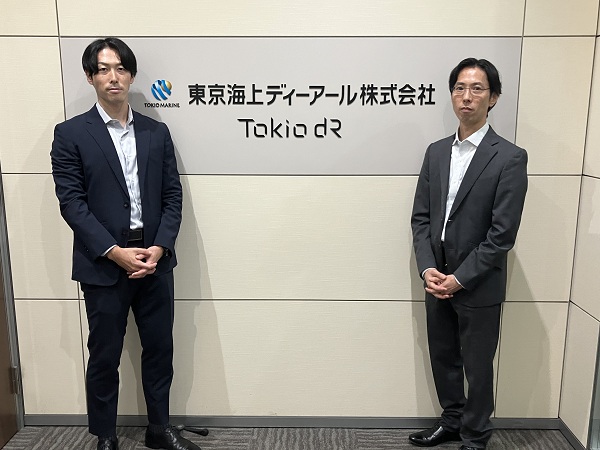
Senior Principal Researcher, Business Resilience and Risk Management Department, Tokio Marine dR
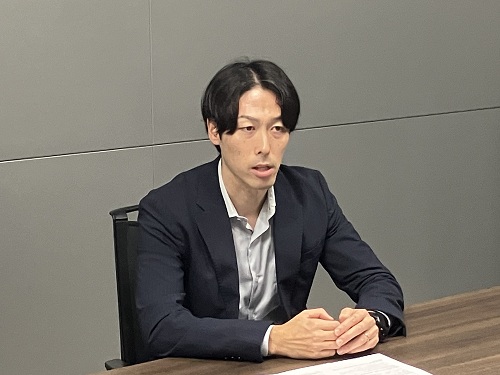
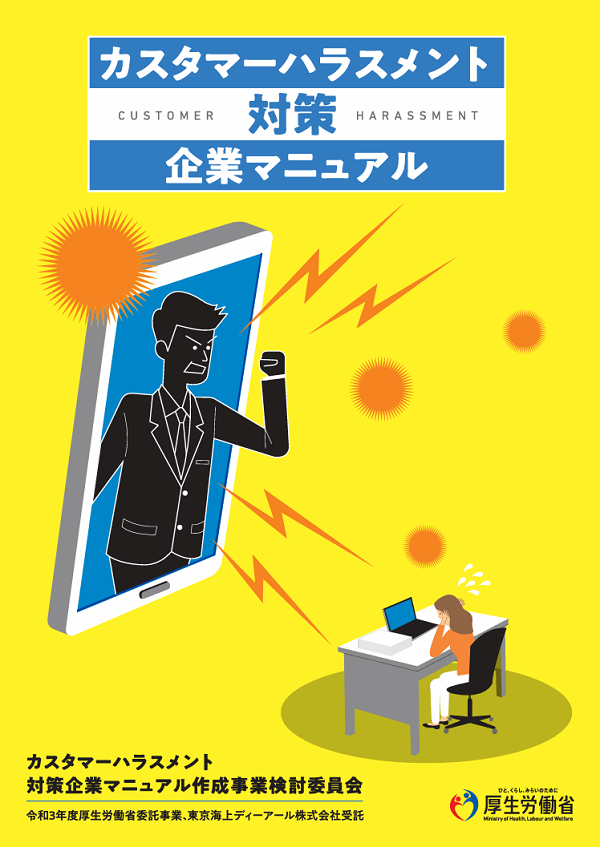
TdR has been involved with the Ministry of Health, Labour and Welfare’s development of a customer harassment prevention manual since the process began in 2022, and has consistently supported advancing Japanese national policy through subsequent revisions. Chida, who has helped many companies in different industries address customer harassment, recalls a memorable case.
When I was giving a seminar at TdR on customer harassment, someone asked, “Which industries are covered?” I remember the buzz in the room when I answered, “All industries.” The person who asked was working in an industry that had daily contact with customers. They were really surprised, immediately asking, “Is our company included, too?”
The revised Act on the Comprehensive Promotion of Labor Policies, which came into effect on October 1, 2026, requires all employers, regardless of their industry or size, to take employment management measures. These measures include clarifying and communicating a policy to respond to customer harassment, establishing a consultation structure, and responding promptly after an incident. Although the law imposes no direct penalties, employers that fail to take appropriate action risk litigation over a breach of their duty of care to ensure employee safety.
Some of the companies that approached TdR for help did so even before legal reform became a subject of discussion. These companies are clearly motivated to address their challenges and improve, even if doing so costs them money. In contrast, some companies don’t feel as much urgency. They remain lukewarm about the law, haven’t grasped its details or assume it doesn’t apply to them.
Frontline realities

In a Ministry of Health, Labour and Welfare survey on harassment, one in four people who experienced customer harassment said they had done nothing about it. The reason these victims end up suffering in silence has much to do with the structural challenges specific to each industry.
Parcel delivery, for example, is a high-risk industry. Due to the nature of their work, delivery drivers are often alone with customers. If harassed, it can be difficult to seek immediate help. In an interview conducted as part of a Ministry of Health, Labour and Welfare initiative, I heard about an incident in which a driver was suddenly punched while carrying a parcel from the truck to a customer’s home. This sounds extreme, but there are cases that amount to criminal offences.
In the hospitality industry, although the 2023 amendment to the Hotel Business Law has made it permissible to refuse guests who make excessive demands, frontline staff remain torn between these new rules and the industry’s long-standing culture of hospitality. In healthcare, professionals have a duty of care (a legal obligation to not refuse care without a justifiable reason), which makes it difficult to turn away patients, even when faced with aggressive behavior.
The crux of the problem is that the line between a legitimate complaint and customer harassment can be hard to draw. When a company’s service falls short, it can be difficult for staff to respond firmly to a customer, even when their behavior crosses the line and becomes unreasonable. Despite having a system in place, frontline employees may be unable to act.
Looking beyond the manual

At one company supported by TdR, a customer who had repeatedly made malicious complaints suddenly stopped after the company published its response policy. Clarifying the policy gave employees a sense of security that the company would protect them. Making the policy public led to a change in the customer behavior. However, there are times when the manual alone is not enough.
About two years after their manual was created, one company came back with another request. When we surveyed their frontline staff, we found that even those who knew there was manual didn’t always know what was in it, so they would deal with incident based on past work experience. At TdR, we help companies reassess the situation from the ground up, so we asked: is revising the manual enough, or are there other underlying issues?
There is a big difference between knowing something and being able to respond under pressure. When harassed by a customer for the first time, many people find themselves unable to think clearly. Even when a consultation service exists, many employees still keep the problem to themselves, either because they don’t want to make a big deal of it or because they fear being blamed.
Creating a manual is just the beginning. For countermeasures to work, it is essential to have cooperation between frontline staff, managers, and the head office, as well as the continuous implementation of a PDCA cycle.
The case for regular training
Through a Ministry of Internal Affairs and Communications program, Sekimoto interviewed 15 local governments nationwide about their current customer harassment situation and how it is addressed. Through his experience, he has come to strongly believe that knowledge alone cannot protect employees.
Speaking with various local governments, I found that quite a few had introduced role-play-based training for dealing with customer harassment. In many cases, employees freeze up when they first face customer harassment. I believe an employee’s ability to respond to a real incident depends greatly on their familiarity with such situations.
When facing customer harassment alone, the staff’s first priority is to protect themselves. If there is any risk of violence, they should leave without hesitation. If the customer continues to lecture them, they should say something like: “I’ve already given you my answer. That’s the end of this conversation,” and then leave. They need to understand that by doing so they are not running away, but are handling the problem in the way that is best for the organization.
Principal Researcher,
Business Resilience and Risk Management Department,
Tokio Marine dR
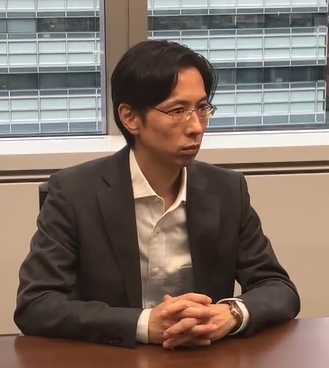
Whether an employee can stay calm and say what they need to ultimately depends on their training. When experiencing customer harassment for the first time, they may find it difficult to step away while emotions are running high. Developing the ability to consciously distance oneself from the situation without getting emotionally overwhelmed is an essential measure that goes beyond policies and procedures.
An end-to-end solution
TdR’s customer harassment consulting service provides tailored support for companies, from assessing the situation and surveying actual conditions to preparing a manual and implementing training. However, there are areas that consulting alone cannot cover.
In September 2026, Tokio Marine & Nichido launched Talktice, a customer harassment prevention support service. In this role-play-based training system, an AI avatar simulates customer harassment scenarios, enabling employees to practice at their own pace until they are accustomed to handling such situations.

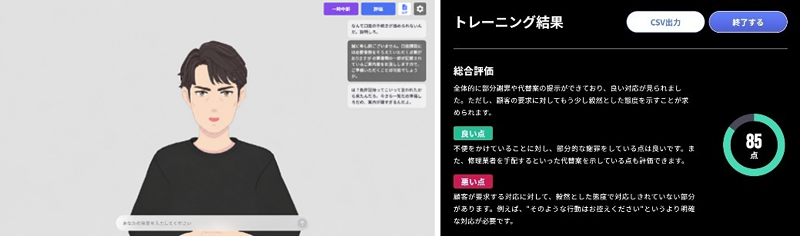
In addition to TdR’s customer harassment consulting services and Talktice, Tokio Marine Group offers further support, including access to a clinical psychologist for consultation and coverage of expenses incurred in the event of a customer harassment incident.
Overview of Tokio Marine Group’s Customer Harassment Prevention Solutions
| Function | Provider | Key Services & Roles |
|---|---|---|
| System development / Consulting | Tokio Marine dR | |
| Establishment of consultation services and victim support | Tokio Marine & Nichido Medical Service | |
| Employee training | Tokio Marine & Nichido | |
| Risk financing | Tokio Marine & Nichido |
-Employment related liability coverage rider |
System development → Consultation structure → Employee training → Risk financing
Tokio Marine Group companies work together to offer end-to-end support for customer harassment prevention and response.
Beyond drafting manuals to comply with legal revisions, I would like companies to see our services as a means to address challenges and create a better working environment for employees. Customer harassment countermeasures can lead to higher employee engagement and become an important pillar of human capital management. Implementing these measures help strengthen a company’s competitiveness.
In companies where customer harassment measures are effective, employees are able to respond firmly, which helps reduce the number of harassment incidents and stabilize the quality of customer service, creating a virtuous cycle.
Our goal is a society in which it is natural for service providers and customers to interact as equals. No single company can achieve this alone, but I believe we can make progress if national and local governments, industry associations, labor unions, and companies work together.
Through end-to-end customer harassment prevention measures, Tokio Marine Group aims to build new relationships among companies, employees, and customers, and offer more than short-sighted solutions to comply with legal revisions. Our scope and expertise allow us to combine the solutions developed by each Group company into a holistic service to address this important social issue.