The Road to Smart Cities and Beyond
- Social Issues & Advancing Society
- Insurance & Risk Insights
The 4th Industrial Revolution is redefining mobility, reshaping how vehicles are manufactured and operated, and how risk itself is created, shared, and managed. As electrification, connectivity, and vehicle automations accelerate, the automotive ecosystem is evolving rapidly into a complex, software‑driven and highly interconnected system. This transformation is bringing enormous benefits, offering a safer, smarter, and more efficient mobility system. At the same time, it is challenging long‑standing assumptions about insurance and liability.
In this article, we explore how this automotive megatrend is reshaping the risk landscape across vehicles, manufacturers, and insurers, giving rise to smart cities in the process. Insurers have a critical role to play in accelerating the progress of these transformations and inspiring confidence in their adoption. Our ability to anticipate and proactively manage system‑level risk will be essential to foster innovation and allow the future of mobility to scale responsibly.
The 4th Industrial Revolution megatrend
The 4th Industrial Revolution megatrend
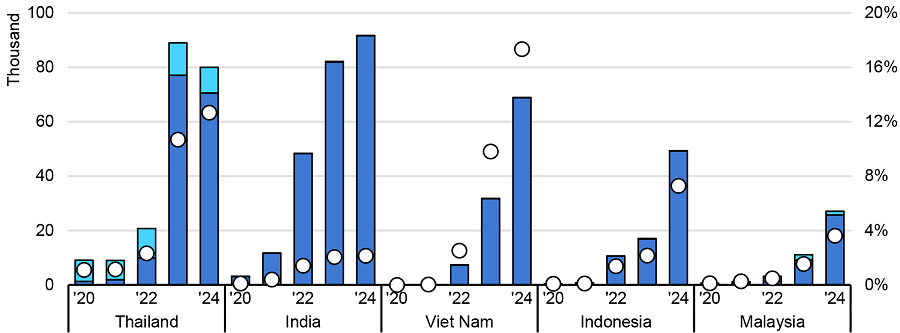
The 4th Industrial Revolution is propelling the rise of electrified, connected autonomous vehicles. While global EV sales have accelerated sharply over the past decade, adoption has been far from uniform, with growth concentrated in a small number of leading markets.
Source: International Energy Agency (IEA), Electric vehicles
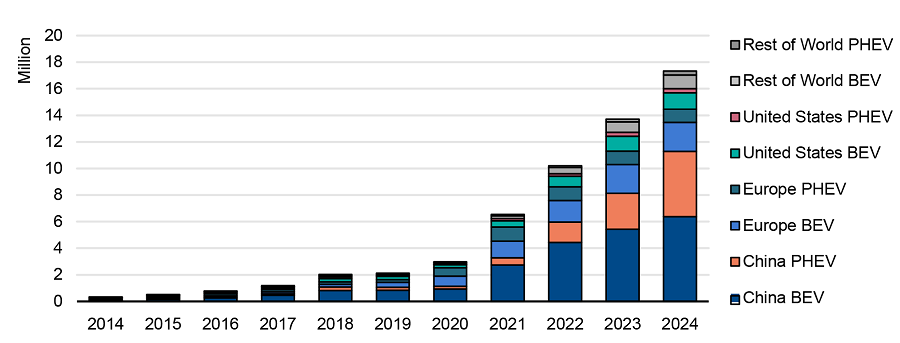
Understanding the changing risk landscape is essential, since simply looking at adoption rate data does not capture the complexity of underlying risk profiles. EV risk comprises an intricate interplay of technology and infrastructure, supply chain considerations, and vehicle-specific attributes such as design and operation.
The first key drivers of EV risk we should consider are technology and infrastructure. Changes in battery chemistry, vehicle architecture, and software directly impact safety and repair complexity. In addition, charging infrastructure and local standards shape how vehicles are used, with shifting exposure and usage patterns across markets.
Second, supply chains and production concentrations introduce tariff and trade-barrier considerations. Automakers are increasingly pressured to consider localising manufacturing to mitigate political dependency and distribution risks.
Third, vehicle design changes and strategic choices can affect parts availability and lead times, directly influencing repair costs, repair duration, and the broader vehicle servicing ecosystem.
For insurers, these risk drivers can act as mitigants, for example through improved safety systems, but they can introduce new and unforeseen risks, such as software-driven failures. Because EV risk profiles are dynamic, insurers must move beyond tracking adoption levels toward a more holistic, forward-looking view that anticipates how underlying trends will affect safety performance and insurance loss experience over time.
Source: International Energy Agency (IEA), Global EV Outlook 2025, May 2025
Vehicle manufacturers to service providers
Vehicle manufacturers to service providers
As mobility shifts from individual driver‑centric models to system‑based operating environments, OEMs are evolving into centralised orchestrators of hardware, software, and data. This expansion in scope allows OEMs to exert much greater influence over safety, while also reshaping where risk accumulates within the broader ecosystem.
As OEMs explore and expand into other segments of the value chain, some have moved into the role of risk carrier. While this does not necessarily replace insurers, it does signal a strategic shift, with OEMs increasingly positioning themselves as service providers rather than solely vehicle manufacturers.
Here, OEMs have several competitive advantages. First, as vehicle technology becomes more advanced, they hold critical vehicle and driving data, including information on accident situations and system status. Such data is invaluable for risk assessment, pricing accuracy, and liability determination, while also creating potential new revenue streams. Second, through proprietary parts and software‑locked components, OEMs can exert significant influence over repair costs and claims outcomes. Lastly, the strategies and actions of OEMs can drive vehicle pricing and depreciation. These changes can affect insurance premiums, create gaps between insured values and replacement costs, and introduce behavioural risks.
As a result, OEMs now exert a growing influence over the broader risk landscape, directly impacting insurance premiums and losses, as well as how responsibility and accountability in the mobility ecosystem are determined. Insurers will need not only to understand this evolving risk landscape, but also to proactively navigate and manage these shifting risk dynamics.
A sharper understanding of risk
A sharper understanding of risk
As mobility evolves toward a system-level operating environment, risk also becomes increasingly systemic, concentrated, and correlated. Software updates, driver-assistance technologies, autonomous features, and shared platforms introduce correlated risks that historically did not exist. In this context, insurers will need to sharpen their ability to fully understand complex risks.
Effective insurance response will hinge on the ability to harness AI-driven analytics for processing vast amounts of ecosystem data. Adaptive pricing, together with proactive and intelligent risk selection, will be essential to enable timelier, more forward-looking risk assessment and to mitigate risks before they materialise. Risk selection, pricing, and portfolio management will also become more interconnected, so insurers will increasingly need to anticipate how changes in vehicle technology, operating conditions, or ecosystem behaviour are likely to influence loss outcomes—preferably before those changes are visible in claims data.
Who’s at fault?
Who’s at fault?
As vehicle automation increases, the transition period during which human and machine decision-making coexist is inherently complex. Our familiar legal and insurance liability frameworks blur around the question of accountability. Determining whether the autonomous system was engaged as intended, whether operating conditions were met, and whether control could reasonably have been transferred at the time of an accident can be challenging. At the extreme end of full autonomy, we can imagine manufacturers, system operators and technology providers will bear greater liability for their technology-which on the insurance side would be addressed through product liability or cyber insurance policies. That scenario, however, is still far down the road.
The rise of autonomous vehicles also brings significant ethical considerations, which can be framed through the well-known thought experiment of the trolley problem. In a situation where harm is inevitable, who should decide what to do? If the vehicle is deciding autonomously, when constrained to choose between two negative outcomes, should it prioritise the safety of its passenger, or that of a larger group of pedestrians? Such ethical dilemmas and societal expectations may ultimately influence how autonomous vehicles are designed and where accountability lies.
Well-designed regulatory frameworks will be essential for innovation to scale, and clarity around responsibility will be as important as the performance of the technology itself. The insurance industry will undoubtedly play a key role in shaping how this space evolves in the years to come.
Smart cars, smart cities
Smart cars, smart cities
Autonomous vehicles are paving the way for an integrated mobility network in which vehicles, infrastructure, pedestrians, and urban spaces are designed to function seamlessly, giving rise to smart cities. This shift comes with broad repercussions for urban design. Land currently allocated for transport infrastructure will likely undergo profound changes. We are already seeing such changes, albeit at a small scale, within controlled, infrastructure-ready environments. In cities such as Singapore, autonomous shuttles, pilots within defined districts, and smart transport corridors illustrate how autonomy can support safer movement, smoother traffic flows, and more efficient use of urban areas, beyond what can be achieved through vehicle-level automation alone.
The downside of these efficiency gains is the new forms of dependency they introduce. As vehicles rely more heavily on software, sensors, connectivity, and shared infrastructure, failures that were once confined to individual vehicles can now propagate across systems. Safety therefore becomes an emergent property of the broader mobility ecosystem, shaped by system design, operational discipline, and regulatory oversight.
The Future of Insurance
The Future of Insurance
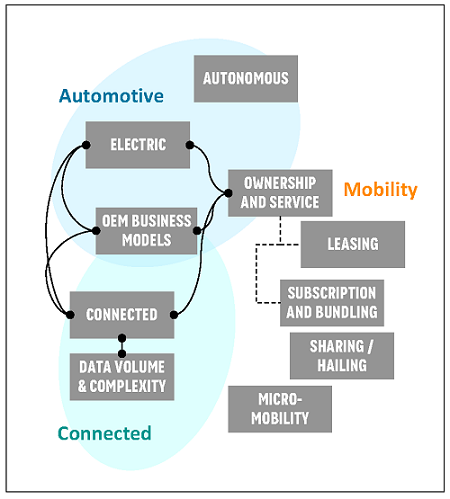
With the rise of smart cities and the transition from “Automotive” to “Connected,” and ultimately to shared “Mobility,” automotive risk is no longer driven primarily by individual behaviour, but by the interaction of technology, infrastructure, regulation, and ecosystem design.
In such an environment, innovation and risk are closely interlinked. New technologies will improve safety and mobility efficiency, but they also introduce new dependencies, risk correlations, and ultimately, a measure of uncertainty.
Source: Celent
The role of insurance has always been to enable; supporting innovation, managing risk, and reducing apprehension of the unknown. Throughout history, insurance has allowed innovations to flourish and societies to advance. The automotive industry will be no exception. Through insurance, we will continue to support the future of mobility, helping deliver on the promise of safer, smarter movement for people and cities.
Author:Allen Juang, Chief Technical Officer, Tokio Marine Asia