The Imabari Model for Decarbonizing SMEs
- Social Issues & Advancing Society
- Insurance & Risk Insights
The only way to achieve Japan’s goal of carbon neutrality by 2050 will be through the participation of SMEs, which account for 99% of all companies in Japan. In practice, however, a lot of businesses don’t know where to begin. While local governments want to provide support, many struggle with funding and expertise.
To address these challenges, the City of Imabari in Ehime Prefecture joined forces with Tokio Marine Group to create the Imabari Model. Working together with the local government, financial institutions, the chamber of commerce, and companies in the region, they built a broad, integrated framework that offers support ranging from securing subsidies to hands-on implementation. The result is a practical mechanism for helping SMEs put decarbonization management into action.
From declaration to implementation
Imabari Chuo Sub-branch (at the time), Ehime Branch,
Tokio Marine & Nichido Fire Insurance Co., Ltd.
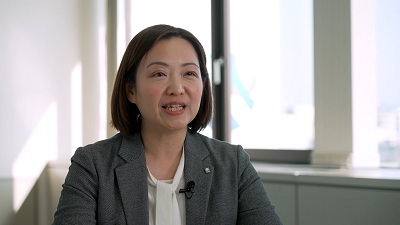
Local government’s three barriers
Imabari is known as a hub for Japan’s maritime industry. Around 70% of the city’s CO2 emissions, however, come from SMEs. Advancing decarbonization required active participation from a broad range of companies.
Many SMEs claimed to know almost nothing about decarbonization and struggled with where to start. The city wanted to support them, but the three barriers of people, budget and expertise stood in the way of decarbonization efforts.
Decarbonized Community Development Facilitator
Environmental Policy Division (at the time), Imabari City
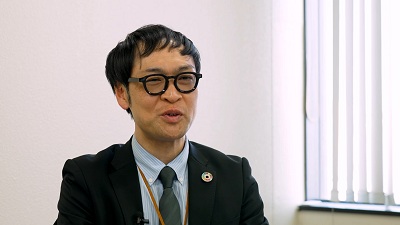
Connecting government, finance, and the chamber of commerce
Ms. Tsumura from Tokio Marine & Nichido’s Imabari Chuo Sub-branch linked up with Tokio Marine Smart GX* to focus on realizing the Ministry of the Environment’s Model Project for Building Regional Support Frameworks for Decarbonization Management. The aim was to become selected for a pilot project in which municipalities and local support organizations work together to support SME decarbonization across an entire region.
-
*Tokio Marine Group’s Japan-based GX support company, providing comprehensive decarbonization management support for SMEs.
As the concept took shape, Imabari City and Tokio Marine & Nichido created what became known as the Imabari Model. At its core is the Imabari Decarbonization Management School, a four-module program for local SMEs. Offered free of charge, the program helps companies acquire the knowledge and practical know-how needed to advance decarbonization management through three key steps: Understand, Measure, and Reduce. Participants who complete the program are certified as Imabari Green Fellows and go on to serve as local decarbonization champions.
However, the framework itself was not enough to secure buy-in from SMEs. They were dealing with a wide range of business issues—such as improving profitability and securing talent—so decarbonization was not necessarily a top priority.
To promote engagement, Ms. Tsumura turned to local banks and the chamber of commerce. Through repeated dialogue with Iyo Bank, Ehime Bank, and the Imabari Chamber of Commerce and Industry, a regional support structure was built to encourage companies to take action. Because these organizations could speak directly to business leaders through trusted relationships, SMEs began to see decarbonization not as an external demand, but as an issue closely tied to their own management challenges.
In this way, a region-wide support system was established. In fiscal 2024, the initiative was selected for the Ministry of the Environment’s pilot project, and the Imabari Model officially began moving forward as a mechanism for regional transformation.
Building awareness, changing behavior, and supporting action
Awareness: A card game to make it personal
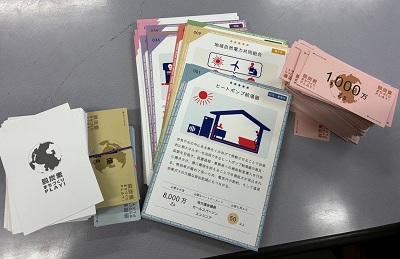
To start with, the program introduced a card game that simulates greenhouse gas reduction. Set in a fictional town, participants take on the role of residents and choose decarbonization actions like installing solar panels or purchasing electric vehicles. They can then see firsthand how those actions change the town.
In the fiscal 2024 post-program survey, all respondents said the experience was enjoyable. Decarbonization began to shift from being a distant issue to one of personal relevance.
Behavior: Lessons from the Imabari Decarbonization Management School in practice
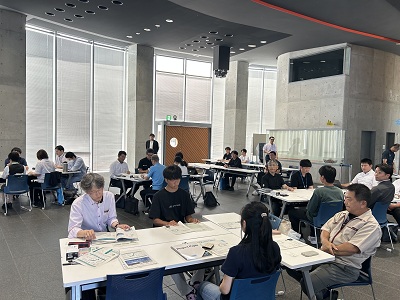
Following the Ministry of the Environment’s three-step approach of Understand, Measure, and Reduce, participants measured their own company’s CO2 emissions and created reduction roadmaps looking ahead to 2050. While the program is free, it is designed as a highly practical course that enables participants to develop implementation-ready plans.
One of the most stimulating elements for participants was the cross-industry group discussion. From shipbuilding to hospitality and manufacturing to services, when business leaders from different sectors sat at the same table, they developed a shared understanding of decarbonization as a challenge for the entire region.
Action: Sustainable implementation through the Smart e-Navi
The Imabari Model goes one step further, introducing companies that participate in the Imabari Decarbonization Management School to Smart e-Navi*, a one-stop service that provides expert support and optimal solutions tailored to each client’s needs and CO2 emissions profile. To make expert support more accessible to SMEs, Imabari City covers the first-year usage fee.
-
*A service for SMEs developed by Tokio Marine Smart GX.
A local ryokan begins its decarbonization journey
Located within a national park in the Seto Inland Sea, Umiyado Chitosematsu is surrounded by lush natural beauty. Precisely because of this environment, the inn’s owners have been striving to become more environmentally friendly, as they contemplate passing on the business to the next generation.
“We explored what we could do ourselves and consulted the chamber of commerce. That was when we were introduced to Tokio Marine & Nichido as GX specialists,” owner Ms. Yano recalls.
Umiyado Chitosematsu (Ryokan Business)
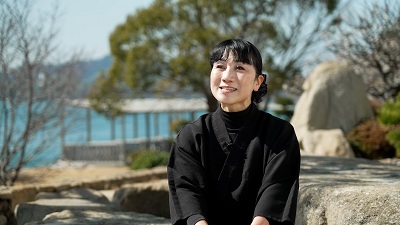
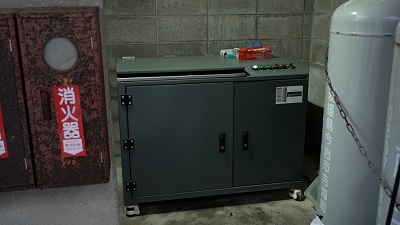
The blind spot: food waste
“We were able to identify an issue we weren’t aware of and think through a solution,” they explained. Tokio Marine & Nichido and Tokio Marine Smart GX introduced the company to a provider of equipment that can quickly decompose and recycle waste, which they decided to install.
Reducing oil use for the hot springs
Umiyado Chitosematsu’s decarbonization journey didn’t end there.
The ability to heat water is indispensable to running an inn with a hot spring. The use of heavy fuel oil is difficult to avoid. Unless they could reduce the amount of oil they use in their core business operation, meaningful decarbonization would not be possible.
The inn contacted Ms. Tsumura asking for ideas on reducing heavy fuel oil consumption by half and transitioning toward renewables. With Smart GX, she developed multiple options, including solar panels, solar thermal systems, and the purchase of electricity from new power providers such as Smart e-Denki. Discussions are ongoing to determine which approach is best suited to the inn’s specific characteristics.
The Imabari Model expands
In fiscal 2025, Imabari City was selected as a Leading Decarbonization Area by the Ministry of the Environment, reflecting the effectiveness of the Imabari Model.
This fiscal year, the Imabari Model entered a new phase. It was the only case to be selected nationwide for the Ministry of the Environment’s Horizontal Expansion Framework by Model Regions. This means it has been recognized not merely as a successful case, but as a replicable model. The framework proven in Imabari is now spreading to nearby Yawatahama City and Uchiko Town.
Companies that participated in the regional initiative were delighted to learn across industries and gained a better understanding of subsidies and policy measures.
“Before, we felt isolated, not knowing how to move forward,” says Mr. Sumiyoshi. “Now, it feels like the entire region is moving in the same direction.”
Using the social challenge of decarbonization as an entry point, Tokio Marine is engaging deeply with regional business management and supporting local companies through a combination of insurance and solutions. We will continue to look beyond insurance as we work to solve the pressing issues of our time.
Featured Individuals
Yuko Tsumura
Tokio Marine & Nichido Fire Insurance Co., Ltd. / Ehime Branch, Imabari Chuo Sub-branch (at the time)
A sales representative responsible for Imabari City. Since the signing of the comprehensive partnership agreement in 2020, she has worked closely on local issues and led the Imabari Model through its design and execution.
Jun Sumiyoshi
Imabari City / Environmental Policy Division (at the time) / Decarbonized Community Development Facilitator
The leader responsible for turning Imabari City’s Zero Carbon City declaration into reality. He worked with Tokio Marine & Nichido to build the Imabari Model while confronting the challenge of SME participation.
Mayumi Yano
Umiyado Chitosematsu / Ryokan business / Owner
She manages a hot spring inn located in a national park in the Seto Inland Sea. With a view to passing the business on to the next generation, she is working to create an environmentally friendly ryokan.