A Different Winter Is Coming—Why Record-Breaking Snowfall Is Occurring Under Climate Change and How We Should Prepare
- Social Issues & Advancing Society
-
*This article was originally published in “SENSOR” by the Tokio Marine Research Institute.
Common sense might lead us to believe that if the planet is warming, we should experience less snowfall. Yet, in recent years, we have seen one report after another about record snowfall in certain areas. How can snowfall be intensifying if average global temperatures continue to hit new highs?
The answer lies in how global warming produces new snowfall patterns. In this piece, we will analyze how winters in Japan have been changing, and what residents can do to deal with this new reality.
An uneven rise in temperatures
First, it’s important to understand the background of how climate change is progressing around the world. Let’s take Japan as an example.
Increasing concentrations of greenhouse gases in the atmosphere are causing a rise in global average temperatures, up more than 1.5 degrees Celsius compared to pre-industrial levels.*1 But this temperature increase is not uniform. Japan’s rise is outpacing the global average, which may have to do with sea water temperatures in the seas around Japan increasing at a higher rate than the global average. These background changes are believed to have an effect on snowfall depth.
Japan’s changing winter
So, how has winter in Japan changed, and what will it be like in the future? If global warming is advancing, shouldn’t Japan be experiencing less snowfall?
Well, it is. Rising temperatures mean snow is more likely to turn into rain, and across the whole of Japan*2, we have observed a long-term trend of decreasing snowfall. The decrease, however, is not linear. Several studies reported that snow depth is trending downward on the national level, but in certain regions, given specific conditions, the likelihood of record-breaking heavy snowfall is actually on the rise. *3
Climate change is exacerbating a duality: average snowfall is declining, but when snow does fall, it tends to be extreme. This trend is also common for rainfall . The underlying climate conditions are as follows:
-
Rise in temperature ⇒ Less likely for snow to accumulateRise in sea surface temperature ⇒ Increase in atmospheric water vapor and instability ⇒ When it does snow, snowfall is heavyMeandering of the subarctic jet stream (the main current of the westerlies that flow at an altitude of approx. 10 km) ⇒ Expansion of the southward swing of cold air ⇒ Cold air in the polar region is more likely to reach Japan
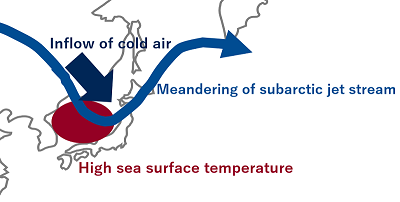
These multiple processes are occurring simultaneously. A recent example we saw was in February 2025, when heavy snowfall, blizzards, and windstorms spanned over a wide area along the Sea of Japan, affecting the North and West of the country.
Looking back at the meteorological conditions at that time, the subarctic jet stream meandered over the Far East, creating a pattern in which cold air from the Arctic region was better able to flow down toward Japan. Additionally, sea surface temperatures in the Sea of Japan were higher than average. These situations precisely coincide with the process described earlier.
Furthermore, studies that quantitatively examined the impact of climate change in this case have reported an increase in snow depth due to climate change ranging from 6 % to 10 %.*5
Preparing for extreme heavy snowfall
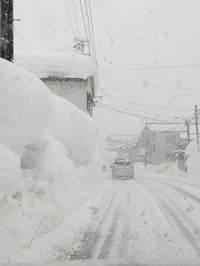
The increase in the frequency of extreme heavy snowfall poses far-reaching concerns. Table 1 lists four closely interrelated items. While these impacts have long been recognized, the risk of extremely heavy snowfall necessitates a re-examination and strengthening of countermeasures.
To address the layered impact of heavy snowfall, preparations and countermeasures must be implemented year-round. Table 2 summarizes countermeasures by category, distinguishing between preparedness during normal times and actions to be taken immediately before and during snowfall. The table also shows both basic prevention measures and business continuity measures.
| Item | Details |
|---|---|
| Impact on traffic and infrastructure | • Highway closures and rail service suspensions • Airport closures and flight cancellations • Suspended logistics • Power outages and communication disruptions |
| Damage to buildings and facilities | • Building damage or collapse due to excessive snow loads |
| Economic impact | • Suspension or shortening of company operations • Crop damage • Decreased tourism • Increased snow removal costs |
| Impact on health | • Accidents during snow removal • Physical deterioration due to conditions such as hypothermia |
| Timing | Preparedness during normal times | Preparedness and measures immediately before and during snowfall |
|---|---|---|
| Basic measures | • Decide in advance how to respond to weather information, such as changing your plans if a heavy snow warning is issued • Stockpile food, water, and supplies to deal with a power outage at all times • Prepare winter tires and tire chains if there is a possibility that you will need to use your car • Confirm in advance for areas where snowfall is likely to occur |
• Avoid unnecessary outings and travelling by car • Remove snow at frequent intervals while ensuring safety • Check that ventilation and exhaust vents are not blocked by snow • Secure means of communication and warmth in anticipation of possible power outages and isolation |
| Business continuity measures | Clearly define in the business continuity plan (BCP) the procedures to be followed in the event of heavy snowfall (e.g., methods for confirming employee safety, criteria for downscaling operations, and the use of telework) and ensure that these are thoroughly communicated to all employees. | In light of heavy snow warnings and anticipated traffic disruptions, prioritize employee safety by downscaling operations and avoiding unnecessary commutes or business travel. Confirm personnel safety, prioritize safety, and continue only critical operations |
In conclusion
Global warming will reduce average snowfall and snow depth on a global scale, but may also cause extremely heavy snowfall events to increase in certain areas. We will need to better understand this characteristic of climate change, where snowfall averages decrease while extremes increase, and embrace new risk management approaches that go beyond conventional methods based on past experience. Especially for companies, it is urgent to comprehensively review BCPs, diversify supply chains, and establish telework programs.
-
*1
-
*2
-
*3
-
*4
-
*5
Author:Tokio Marine Research Institute, Senior Researcher (seconded from Tokio Marine dR Co., Ltd.) Rumi Ohgaito
Related articles
Global Warming’s Dual Extremes: More Wildfires and Heavier Rain