Preparing for a Major Flood Disaster in the Tokyo Metropolitan Area (Part 1)
- Social Issues & Advancing Society
-
*This is a reprint of an article in SENSOR, the newsletter published by the Tokio Marine Research Institute.
When you picture disaster evacuation, where do you see yourself going? For most people, the answer tends to be a designated neighborhood shelter, like an elementary school or community center. However, in the event of a major flood, that evacuation plan may not be enough.
This article will be divided into two parts. In Part 1, I will primarily discuss the expected challenges when evacuating during a large-scale flood in the Tokyo metropolitan area. In Part 2, I will outline necessary countermeasures. This information is meant to help not only for those living in Tokyo, but also residents of other major cities like Osaka and Nagoya who may face similar challenges.
1. The dangers of high population concentration
Fortunately, the Tokyo metropolitan area has not experienced major flooding since Typhoon Kathleen in 1947. However, should a flood occur in the future, Tokyo’s unique characteristics will necessitate distinct evacuation measures.
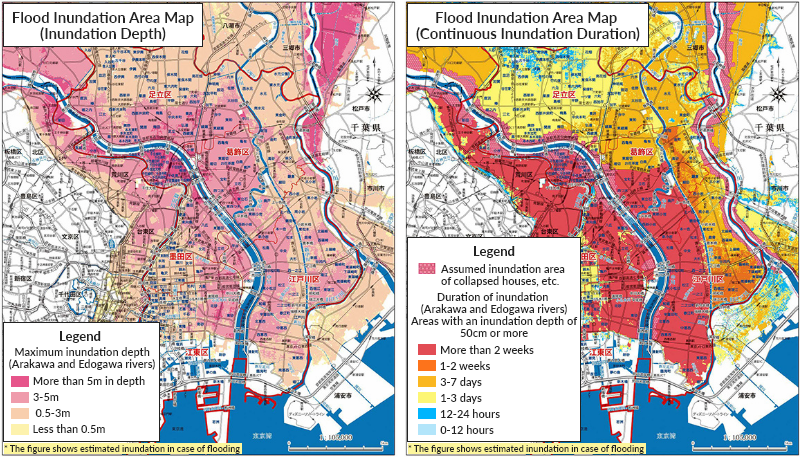
Figure-1 shows the hazard map for the five Koto wards (Sumida, Koto, Adachi, Katsushika, and Edogawa) of eastern Tokyo in which inundating is expected during a large-scale flood disaster. Compared to other regions, these areas are characterized by deeper inundation for a longer period of time and across a wider area. Furthermore, the population of the five Koto wards is a massive 2.55 million*1, with over 90% of residents living in vulnerable zones*2. For these reasons, evacuation in these areas presents numerous challenges.
2. No guaranteed shelter solution
First, deep inundation means that residents, especially those living in detached houses or the lower floors of apartment buildings, will need to evacuate and seek shelter outside their homes. In the five Koto wards, many homes will be inundated up to the second floor, make them temporarily uninhabitable. But what about the residents on higher floors, where the risk of flooding in living quarters is low?
Here are some of the challenges that those who choose to remain in their higher-floor homes might face.*3
In the home, the heat and humidity of typhoon season can be a major strain on hygiene and mental health.
-
Can’t do laundry
-
Refrigerated foods will perish
-
TVs and mobile phones won’t work
-
Elevators will stop
-
Upset stomach
-
No water when thirsty
-
Even when it’s hot, air conditioning won’t work, leading to heatstroke
-
Toilets won’t flush
-
No hospital access, prescriptions will run out
-
No garbage disposal, leading to accumulation
When a large-scale flood disaster occurs, electricity, gas, and water services are cut off, heavily disrupting daily life. Floods often occur during hot weather, but air conditioners won’t function and toilets won’t flush. While it may be possible to endure these conditions for a day or two, any longer will be difficult. Many areas in the five Koto wards can experience inundation lasting for over two weeks. In addition, given the sheer size of the population, prompt rescue efforts will not be accessible to everyone.
So what about evacuating to a nearby shelter? Unfortunately, many evacuation shelters in the five Koto wards will also be inundated. Total estimated capacity for shelters is approximately 170,000 evacuees, while the number of residents requiring evacuation through relocation is estimated at 1.78 million. Among them, the number of elderly people and people with mobility issues who require priority evacuation, along with their caregivers, is estimated at 620,000. So even if you go to a shelter, the chances of getting in are extremely low.
I have raised three key points up to now: (1) Many residents of detached houses will need to relocate, (2) even residents on higher floors not affected by flooding will face prolonged difficulties, and 3) evacuation shelter capacity is vastly insufficient. Therefore, in the event of a large-scale flood disaster in the Tokyo metropolitan area, people will need to evacuate across a wide area, and go beyond local administrative boundaries, to other wards or even prefectures.
3. The challenges of evacuating wide areas
Unfortunately, such widespread evacuation is not easy. Given the huge number of people affected, initiating evacuation once the risk of flooding is significant will result in severe congestion. For those evacuating by train, stations will be very crowded and people will struggle to get on board. Rail services may also be suspended, stopping train evacuation altogether. For those evacuating on foot, bridges and intersections will become bottlenecks. Crowd surges may occur, posing a significant danger. The issue when each resident tries to take the best possible action to protect their own life is that other evacuees end up becoming obstacles.
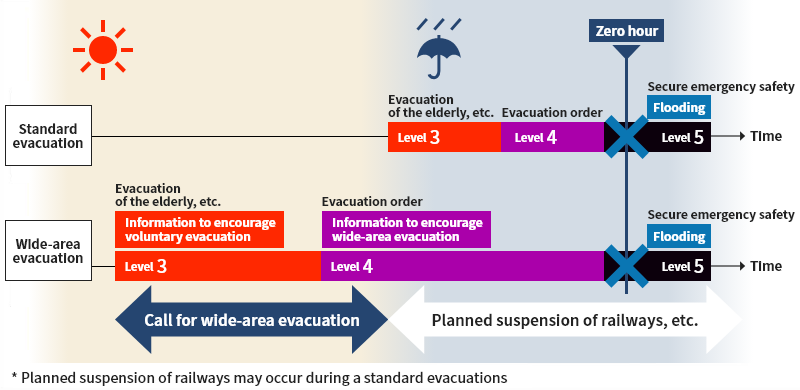
To evacuate safely, it is necessary to begin evacuating early. Figure-3 illustrates the difference in timing between standard and wide-area evacuations. In some cases, the best time to being evacuation is when the weather is still clear, but with commitments like work and school, doing so may not be easy. Furthermore, since the accuracy of weather forecasts is always limited, calling for earlier evacuation increases the likelihood of false alarms.
Even early evacuation comes with its own set of challenges. There is no guarantee that surrounding municipalities will be able to secure shelters capable of accommodating the vast number of evacuees from a wide area. Just because you manage to evacuate safely from the five Koto wards to surrounding municipalities doesn’t mean you will necessarily be able to secure safe shelter.
4. In closing
This first part focused on pointing out challenges, as my hope was to illustrate that evacuation in the event of a large-scale flood disaster in the Tokyo metropolitan area differs from typical flooding and presents unique difficulties. In Part 2, I will discuss ways to evacuate in the event of a large-scale flood disaster in the Tokyo metropolitan area and what companies can do to help.
-
*1Working Group on Large-Scale and Wide-Area Evacuation from Floods and Storm Surge Flooding: Quantitative Calculation Methods for Large-Scale and Wide-Area Evacuation from Flood and Storm Surge Inundation and Specific Study Examples in Five Koto Wards, 2018.
-
*2Council for Koto 5 Wards Wide Area Disaster Evacuation: Floods Hazard Maps for Large Scale Floods in Koto Five Wards, 2018.
-
*3What life might look like if you stay at home. Excerpt from the “Edogawa Ward Flood Hazard Map (Main Edition)”.
-
*Reference links only available in Japanese