Insurance and Rail Join Forces to Eliminate Crossing Accidents
- Social Issues & Advancing Society
Most of the railway crossings in Japan are notoriously secure, with crossing gates and alarms that ring when a train is approaching. These are known as Class 1 level crossings and make up for roughly 30,000 installations across Japan. However, Japan still counts 2,400 crossings with neither alarms nor gates. Known as Class 4 level crossings, they have been the site of 57 collision deaths in the last ten years. (* As of January 2024.)

-
*Source: Created by Tokio Marine based on the Ministry of Land, Infrastructure, Transport and Tourism's "Current Status of Railroad Crossings"
Chiba Prefecture has the most Class 4 level crossings in the Kanto region and the fifth most nationwide. Choshi City alone has four such crossings. They intersect with roads that serve a vital purpose for the community but have long posed safety issues which have proven difficult to remedy. Installing alarms and gates costs at least 15 to 30 million yen (roughly $100k-200k) per location and requires the understanding and cooperation of local residents, which isn’t always straightforward. Despite broad recognition of the dangers, little progress has been made in implementing countermeasures.
In response, Choshi Electric Railway Co., Ltd. and Tokio Marine & Nichido Fire Insurance Co., Ltd. (TMNF) have joined forces with the mission of building safer and more secure communities. We spoke with Katsunori Takemoto, President of Choshi Electric Railway, and Yohei Inoue, Unit Leader at TMNF about the ambitions underlying the project and the tangible solutions they are working on together.
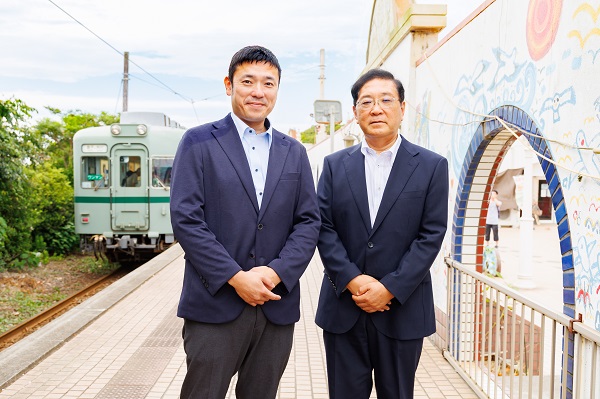
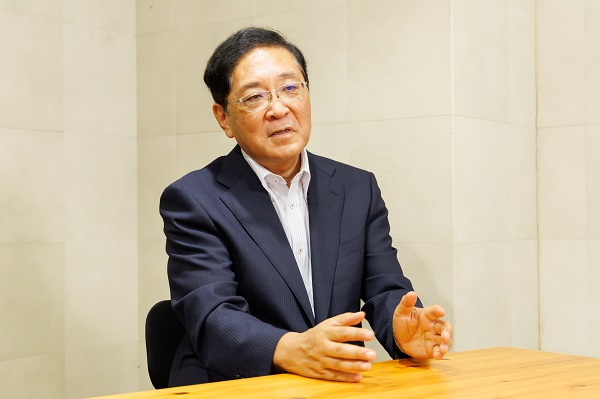
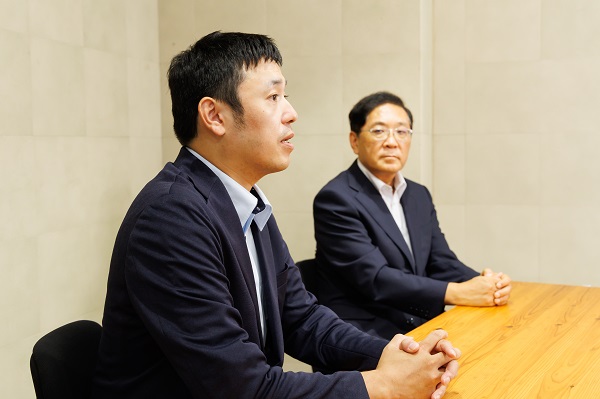
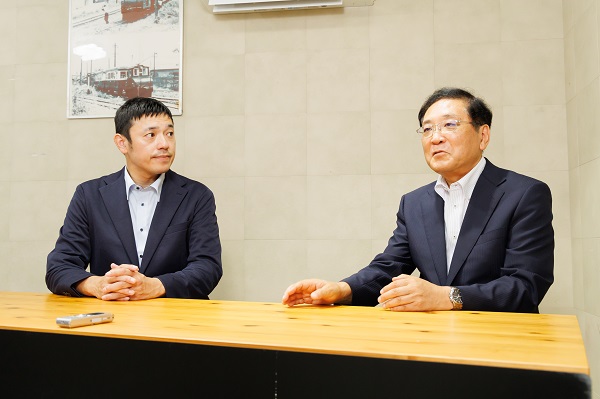
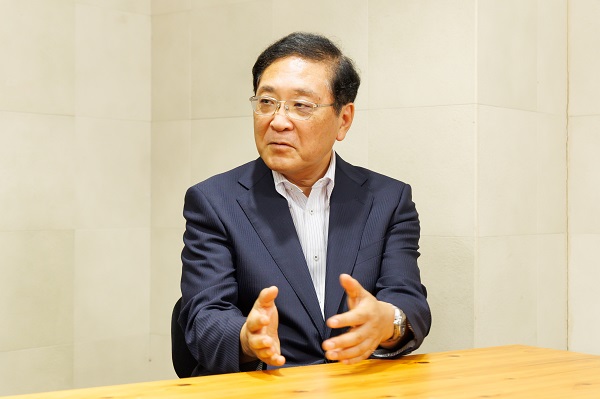
Katsunori Takemoto (right)
President and Representative Director of Choshi Electric Railway, which has been in operation for over a century. His general philosophy is that doing nothing is the greatest risk. Together with his employees, he pursues a style of continuously coming up with humorous and original ideas while striving to maintain local transportation and revitalize the community.
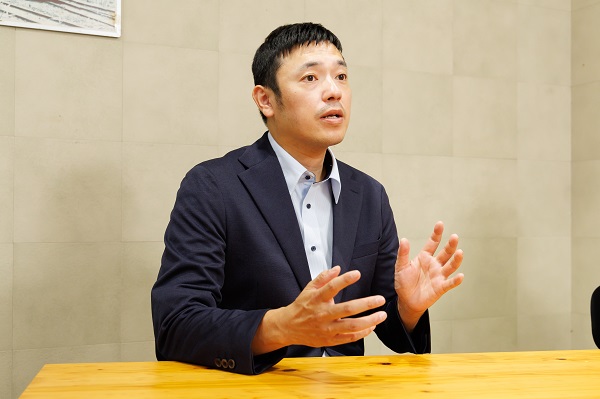
Yohei Inoue (left)
Unit Leader at the East Kanto Claims Service Department of TMNF, he prioritizes driving customer satisfaction through daily accident response while also looking for solutions to address social challenges, even when they go beyond the traditional scope of insurance.
Introducing Choshi Railway
A private local railway line operating in Choshi City, Chiba Prefecture, nicknamed “Choden”. The line runs from Choshi Station to Tokawa Station, covering a distance of 6.4km one-way in about 20 minutes. Choshi Electric Railway engages in initiatives that transcend the typical boundaries of a railway operator, such as selling unique products like the snacks “Nure Sembei” (moist rice crackers) and “Mazui Bo” (unappetizing sticks), selling station naming rights, operating event trains, and producing films.
Addressing dangers in the community
What really got me thinking about this issue was an incident that happened last year in Gunma Prefecture. A local elementary school student was struck and killed by a train at a Class 4 level crossing that had neither crossing gate nor alarm.
The news made me start looking into what kind of countermeasures were being taken nationwide. I was appalled to learn that not only has little concrete progress been made on instituting countermeasures, but also my home prefecture of Chiba has one of the highest numbers of Class 4 level crossings in Japan.
In my role as an accident claims adjuster, I have been present at numerous accident scenes and witnessed tragedies firsthand. I strongly felt that unless someone takes action, this kind of tragedy will continue to occur, and resolved to tackle the issue of Class 4 level crossings.
There are four Class 4 level crossings on the Choden’s route, some with relatively high traffic and others adjacent to Class 1 level crossings. While local residents may be accustomed to the lack of accident-prevention measures, I was concerned that tourists and foreign visitors might not recognize the danger. Also, these crossings can be especially dangerous for vulnerable road users like children and people with visual or hearing disabilities. I felt that taking measures to protect people’s lives and safety was an urgent priority.
Understanding the lack of progress
Implementing safety measures for Class 4 level crossings is no easy task. Crossing gates and alarms can be very expensive. Since Class 4 level crossings are often not eligible for government subsidies, it can be extremely difficult for local railways in rural areas to cover these costs.
The public often frames this issue as an either-or decision between upgrading to a Class 1 level crossing or eliminating the Class 4 crossing altogether. However, as President Takemoto pointed out, the reality is that neither option is simple. Both require significant time, expense, and coordination with local residents.
If a crossing were to be eliminated, residents would be very vocal about the inconvenience of having to make a detour, making it very difficult to get their buy-in. For local residents, these local roads are important for daily life and can’t simply be closed.
Even after the accident in Gunma Prefecture last year, we were told that upgrading to Class 1 crossings would take at least five years. Given the potential for tragedy to strike again in the meantime, I felt the need to think of a new approach.
I visited over fifty Class 4 level crossings in Chiba to confirm the conditions on-site. Among them, the level crossings operated by Choshi Electric Railway in particular saw all kinds of traffic, so I felt that enhanced safety measures were especially necessary.
Which is how Mr. Inoue came to visit our company. We have long recognized the dangers of Class 4 level crossings and felt the need for safety measures, but due to financial constraints, we hadn’t been able to act. When I first spoke with Mr. Inoue, I was deeply moved to find that he shared exactly the same concerns and was impressed by his passion to prioritize solving this social issue. It was also reassuring that he understood our financial situation and was nevertheless enthusiastic to work together.
Starting with safety education for children
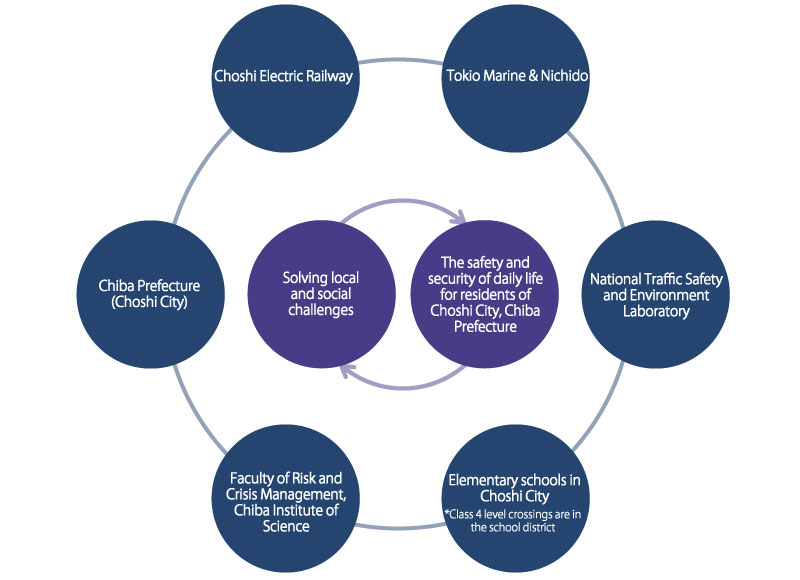
Once we decided to collaborate with Choshi Electric Railway, we quickly saw the need to expand our network of partners. We invited Choshi City, the Chiba Institute of Science, local elementary schools, and independent administrative agencies to participate. Everyone involved was united in our desire to tackle this challenge, so the entire community began to move forward as one team.
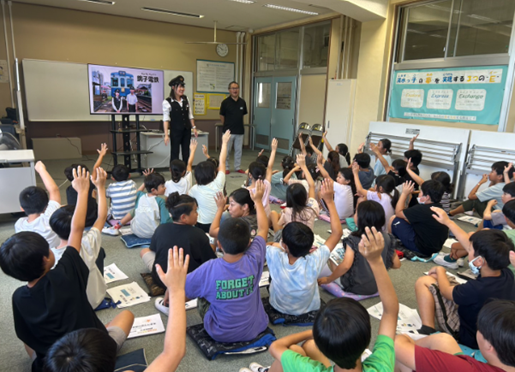
As a first step, I proposed outreach classes at local elementary schools and creating safety maps. We conducted a session this past July, clearly explaining the dangers of Class 4 level crossings to the children. We consciously aimed to make the lessons more practical by leveraging our expertise with accident response and our vast data on past accident cases.
Safety education for children is vital when considering the future of our community. Through the outreach class, both children and schoolteachers gained new insights into the dangers of Class 4 level crossings, including differences in field of vision between adults and children.
Exploring cheaper safety solutions
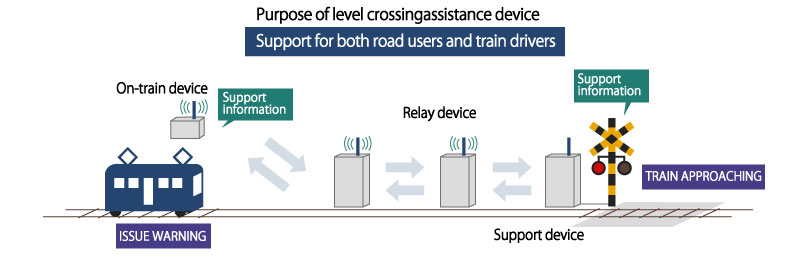
We are also exploring alternative options to replace conventional alarms and crossing gates. In our search for solutions, we learned that an independent administrative agency was developing a safety improvement support device that could be installed at low cost. We asked to partner with their representatives.
The device utilizes common technologies such as GPS and Wi-Fi to alert road users of approaching trains while simultaneously notifying the train driver of the support device’s operational status. We are holding discussions in preparation for the demonstration of this device and are considering a pilot introduction.
When I heard about this device, I was very excited. Given the prohibitive costs involved in upgrading to Class 1 crossings, the prospect of a low-cost solution that could enhance safety is great news for a local railway like ours.
Support through core business activities
As an insurance provider, we are also considering how insurance can contribute to solving this problem; namely through the creation of a specialized insurance policy tailored to accidents caused by entry onto railway tracks or level crossings, for risks not fully covered under existing policies. For example, by covering additional labor costs for employees handling accidents, alternative transportation expenses, and cleaning costs for vehicles and tracks, I believe we could mitigate losses for railway companies and support faster recovery.
Another aspect we are exploring is how we can provide financial support, since asset management is another one of our core business activities. Since level crossing issues can cause a significant financial burden, our support could directly contribute to regional development and revitalization.
Potential for national change
Railways are more than just a means of transportation. They are a symbol. When a region declines, its railways fail. When railways decline, the region loses its vitality. These are two sides of the same coin. Given the symbolic significance, railway accidents can have an overwhelmingly negative impact on the community.
I hope everyone in Chiba Prefecture, the Kanto region, and the entire nation will become aware of the dangers of Class 4 level crossings. The solution begins with a shared sense of urgency that accidents can happen to anyone.
Thanks to Mr. Inoue taking the lead and establishing a framework with diverse stakeholders, what was previously thought to be impossible is becoming closer to reality.
As an insurance company, our role is not to take center stage. That said, we can serve as a hub that supports companies and communities, connect stakeholders with expertise across different fields, and use our expertise in predictive modeling to help offer advice and solutions. Insurance can fulfill such a role precisely because it connects with all manner of risks across society.
We were able to begin our initiatives because you chose Choshi Electric Railway first. I hope this Choshi Model will become a beacon of hope for other local railways as well.
I hope to expand this Choshi Model as a success story to other local railways within Chiba Prefecture, but also further, to other regions facing similar challenges. We want to build a positive cycle that brings forth a more sustainable society by solving social challenges through business activities.
Eliminating Class 4 level crossing accidents is not a challenge that can be solved by systems and companies alone. It will require the awareness of all of us. Knowing the dangers, speaking up, and caring about community safety are the first steps toward transforming society.
The challenge undertaken by Choshi Electric Railway and TMNF may be a small step that began in a rural community. That said, I hope this step will kindle hope across Japan so that life-saving systems can be established across the country.