Preparing for a Major Flood Disaster in the Tokyo Metropolitan Area (Part 2)
- Social Issues & Advancing Society
-
*This is a reprint of an article in SENSOR, the newsletter published by the Tokio Marine Research Institute (TMRI).
The first part of this series focused primarily on the challenges in evacuating the Tokyo metropolitan area during a large-scale flood. Unique characteristics like the size of the affected population present a series of challenges that necessitate evacuation measures distinct from typical flooding.
Part 2 will focus on those necessary measures, how residents of places like the Tokyo metropolitan area can prepare, and what actions to take when flooding is imminent. We will also go over what companies can do in such situations.
1. The concept of “dispersed evacuation”
The Japanese government has conducted extensive studies on evacuations during large-scale flooding in the Tokyo metropolitan area. Current basic policy is based on the concept of dispersed evacuation, the basic idea of which is for each resident to decide how to evacuate according to their individual flood risk and, if evacuating outside their home, to secure their own evacuation site. The process is slightly different for residents who have difficulty evacuating on their own, but for the purposes of this article, I will primarily address those who are able to evacuate independently.
2. Determining an evacuation site
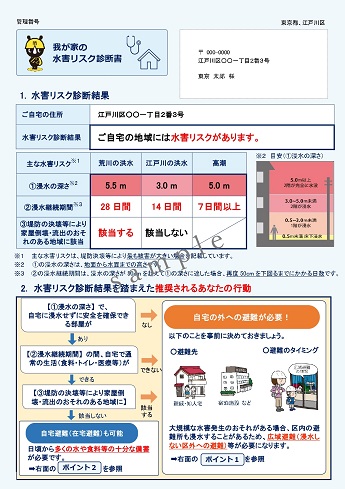
Figure-1 shows a sample of the "Flood Risk Assessment Report for Our Home," sent by the Tokyo Metropolitan Government to residents in parts of the five Koto wards in 2023. Recipients first check their home's flood risk to determine their evacuation site. The key points to consider are the depth and duration of inundation. If inundation is deep or if flooding is expected to last for long enough to cause harsh living conditions (see Part 1), evacuation outside the home will be necessary. Areas near rivers and other locations that are particularly vulnerable to flooding will also require evacuation outside the home. These evacuees must secure their own evacuation sites, whether in a wider area or within the five Koto wards, rather than using shelters provided by the local government. Specifically, this means places not prone to flooding, such as relatives' homes, friends' homes, hotels, workplaces, and so on. In other words, evacuation procedures will vary by resident, and figuring out the best place to evacuate is a matter of personal responsibility.
3. When flooding is imminent
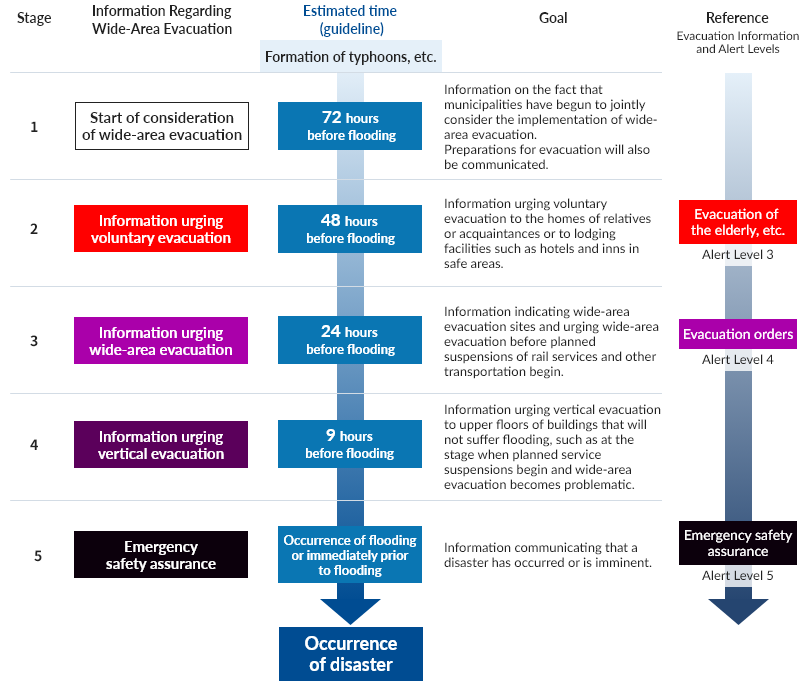
Figure-2 shows the "Wide-Area Evacuation Timeline" that will be implemented if there is a possibility of large-scale flooding in the Tokyo metropolitan area. It is applied based on forecasts of atmospheric pressure, wind speed, rainfall, and other factors, as well as decisions made by local governments.
According to this timeline, wide-area evacuations that take time must begin no later than 24 hours before anticipated flooding, once a “notice urging wide-area evacuation” has been issued. However, a large number of evacuees from a wide area evacuating at the same time risks causing congestion, while public transportation may suspend services. Therefore, once residents see an announcement that wide-area evacuation is being considered (issued 72 hours in advance), they should promptly gather necessary information and begin evacuation. Even when evacuating within the five Koto wards or within residential areas, congestion should be expected.
4. What can companies do?
Evacuations during large-scale flooding in the Tokyo metropolitan area should not be the sole responsibility of individual residents in inundated areas. Companies also have a role to play.
First, when large-scale flooding is anticipated in the Tokyo metropolitan area, employees whose commuting routes cross inundation areas should be exempt from having to come to work. This not only protects the safety of employees, but also helps reduce congestion when residents in flood-prone areas evacuate. The Cabinet Office Working Group report*1 states that in past surveys, while approximately 80% of respondents canceled personal plans when typhoons approached, only slightly over 50% canceled commuting to or from work. This indicates that workplaces must take the initiative in implementing measures to reduce unnecessarily travel.
Furthermore, as mentioned in Part 1, there is an overwhelming shortage of facilities to accommodate wide-area evacuees. Therefore, the Tokyo Metropolitan Government and municipalities receiving wide-area evacuees are seeking to establish agreements to utilize facilities owned by the private sector. Supporting such initiatives is another way companies can contribute.
5. In closing
The key points mentioned in Part 2 are threefold: (1) Residents in flood-prone areas should assess their home flood risk and secure their own evacuation sites if they are required to evacuate their homes. (2) Once the “Wide-Area Evacuation Timeline” is activated, residents should gather information and start evacuating as soon as possible, before areas become congested. (3) Companies can contribute to evacuation efforts by allowing their employees to stay home and offering their own facilities as evacuation shelters. It is necessary for us to understand the unique characteristics of evacuation during large-scale flooding in the Tokyo metropolitan area and prepare for such situations during non-disaster times.
-
*1Central Disaster Management Council, Disaster Management Implementation Committee, Working Group on Evacuation from Disasters Caused by Typhoon No. 19, etc. , in 2019.: Report on Evacuation from Flood and Sediment Disasters in Light of Typhoon No. 19, etc. in 2019, 2020.