No Offense Without a Strong Defense - A 100-year food manufacturer’s perspective on the importance of preparedness: Building a disaster-resilient society
- Resilience
- Insurance & Risk Insights
Kanesada Co., Ltd. (Kanesada) experienced a major fire at its headquarters factory in 2017, and another at its Kanto factory in 2023. Worried a third would decimate the company’s reputation, Kanesada repositioned disaster prevention as a top management priority. One facet of its efforts is to implement accident prevention measures, for which the company partnered with Tokio Marine dR (TdR)*1, a risk consulting service provider and member of Tokio Marine Group.
We spoke with Motoharu Washio, Senior Managing Director of Kanesada, and Tetsuya Murase, Director and Production Division General Manager at Kanesada, about Kanesada’s experience with the two fires, its partnership with TdR, and its current disaster prevention structure.
A century of manufacturing fish paste products
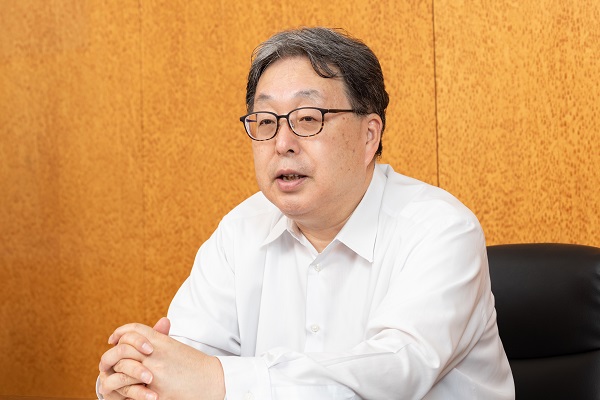
Q: What kind of company is Kanesada?
Mr. Washio: We are a food manufacturer founded in 1925 and engaged in the production and sale of fish-paste products such as chikuwa (tube-shaped fish cakes), kamaboko (steamed fish cakes), and ingredients found in oden, a traditional Japanese hot-pot dish.
Our company is characterized by directly managing stores throughout Japan, with a business model that encompasses both manufacturing and retail.
We currently operate two manufacturing facilities: our headquarters factory in Miyoshi City, Aichi Prefecture, and our Kanto factory in Yachimata City, Chiba Prefecture. We have approximately 280 full-time employees, with a total team of about 1,600 when you include part-time workers, technical interns, and specified skilled workers.
Two fires caused by fryers
Q: What caused the first fire your company experienced?
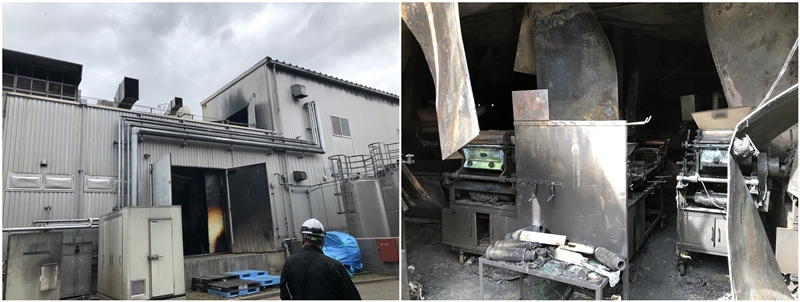
Mr. Washio: The first fire happened in February 2017, late one night when a gas fryer used in the manufacturing process broke out in flames. The conflagration subsequently spread through the ductwork, engulfing the entire factory.
I rushed to the scene immediately and found as many as 16 fire trucks already on site. Due to the risk of secondary disasters, however, they were unable to start fighting the fire right away. By noon, when we were finally permitted to enter the factory, the interior resembled a scorched battlefield.
Q: What about the second fire, at the Kanto factory?
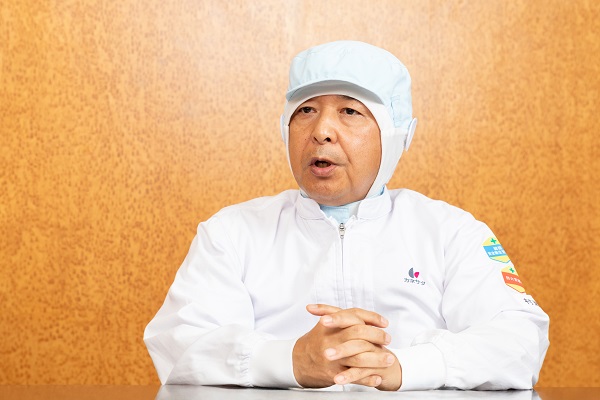
Mr. Murase
The second fire occurred in early March 2023. After the first fire, we replaced the gas fryers at this factory with electric units. This time, however, oil residue from a paddle used to transfer fryer oil is what ignited, and the flames once again spread through the ductwork.
When an employee told me what I happened, I thought, “There’s no way. How could an electric fryer cause a fire?” I couldn’t believe it.
Q: What actions did you take in the aftermath of the accidents?
Mr. Washio: First, we needed to accurately assess the damage to the factory. Since a factory fire was a first for our company, we immediately contacted our insurance agent, Tokio Marine & Nichido Fire Insurance (TMNF).
TMNF subsequently introduced us to BELFOR (Japan) Co., Ltd. *2, a disaster recovery specialist. They provided us with a professional assessment after the fire, which allowed us to quickly determine which equipment was still usable, significantly accelerating the recovery process.
The importance of prevention
Q: What insights did you gain from these fires?
Mr. Washio: That prevention is the best solution. Once an accident has occurred, it is too late to act. It is crucial to take thorough measures to prevent accidents beforehand.
For food manufacturers like us, fires and sanitation incidents can lead to prolonged production halts and cause irreparable damage. Once a client’s trust is damaged, they risk switching to another manufacturer and never doing business with us again. Disaster prevention is expensive, but we are implementing measures with the conviction that through our efforts, we can come as close as possible to covering all contingencies.
Q: What issues have you experienced with disaster prevention measures to date?
Mr. Washio: To be perfectly honest, we were somewhat naive in believing that major accidents would not occur so long as our equipment met legal standards and passed compulsory inspections. To some degree, we were only conducting disaster drills because they were legally required, so disaster preparedness measures might have become a company-wide box-ticking exercise.
Disaster prevention audit standards to thoroughly identify risks
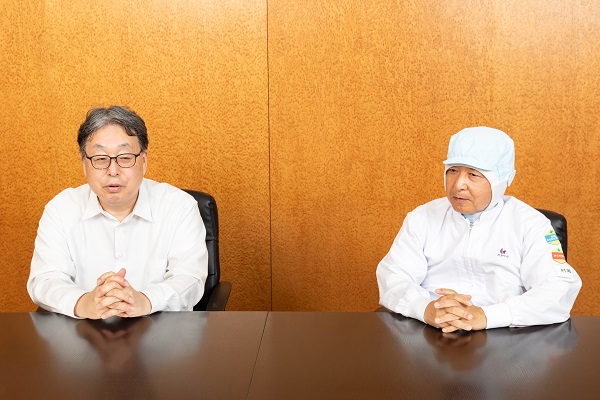
Q: What led you to develop disaster prevention audit standards in partnership with TdR*3?
Mr. Washio: After the first fire, we implemented measures ourselves to prevent recurrence. With the second accident, however, we became acutely aware that there were limits to what we could achieve on our own. That is why we requested TdR to help develop our disaster prevention audit standards.
Q: What was it like working with TdR on this initiative?
Mr. Murase: Mr. Murase: Frankly, I was surprised by how much they did for us. TdR not only thoroughly identified risks we would not have pinpointed ourselves, but also provided case studies from other companies and concrete figures. When we were developing measures on our own, we thought certain situations might be impossible to fully address. Thanks to TdR, we were able to incorporate specific solutions based on examples from other companies into our existing disaster prevention measures.
Q: What are some examples of specific disaster prevention measures Kanesada implemented based on the insights you gained while formulating your disaster prevention audit standards?
Mr. Murase: In terms of equipment, we modified the structure of our factories to separate ducts individually, which should minimize the spread of fires. We also wrapped fire-retardant sheets around equipment to inhibit the spread of flames. Additionally, duct cleaning was previously performed once every two years, but we now hire contractors to do so thoroughly about twice a year.
Mr. Washio: In addition to upgrading our equipment and reviewing operations, we emphasize disaster prevention training for our employees. We provide opportunities for employees to share their experiences with near-miss incidents and display photographs of past fire accidents throughout our factories to ensure the entire company always maintains a high level of disaster prevention awareness.
Q: Have such initiatives led to changes in employee awareness and behavior?
Mr. Murase: I feel that awareness of disaster prevention is steadily growing among employees as a result of the disaster prevention audit standards we developed and our strengthened disaster prevention training. We see greater ownership across each individual task, like for example strictly adhering to the rule of cleaning one fryer line per day.
Q: Are there any other initiatives you implemented to raise employee awareness of disaster preparedness?
Mr. Murase: In response to employee requests, we asked TdR to conduct a Disaster Prevention Seminar. We received a detailed lecture reviewing frontline risks in manufacturing. As feedback, participants in the seminar told us they were better able to recognize pitfalls they hadn’t been fully aware of, and expressed their intention to further strengthen daily inspections.
Investing in proactive disaster prevention
Q: Reflecting on the two accidents, what are your thoughts on the value of investing in disaster prevention?
Mr. Washio: Investment in disaster prevention may incur costs in the short term, but I believe it is absolutely required for long-term business continuity. We strongly feel that a third accident must never be allowed to happen and are making sustained investments in disaster prevention measures without compromising on cost.
In my personal opinion, there is no offense without a strong defense. To increase productivity, we first need to establish a foundation of safety. Defensive investments should be pursued proactively, considering the damage that accidents can cause to our business.
Q: How do you see the future of your disaster prevention structure?
Mr. Washio: Preventing accidents is our highest priority. We will continue to enhance our disaster prevention structure to achieve our goal of zero accidents.
That said, no matter how thoroughly we implement preventative measures, they will never be 100% effective. We plan to advance preparations for initial response measures in parallel with prevention measures, to minimize damage in the event of an accident. We also aim to cultivate a culture in which employees don’t just act out of obligation, but exercise autonomy and take ownership for safety.
Kanesada’s resolve in formulating disaster prevention audit standards
After interviewing Kanesada representatives, we spoke with Yujiro Hatakeyama of TdR’s Property Risk Engineering Department about the context behind the support they provided to Kanesada and what companies should aim for in disaster prevention.
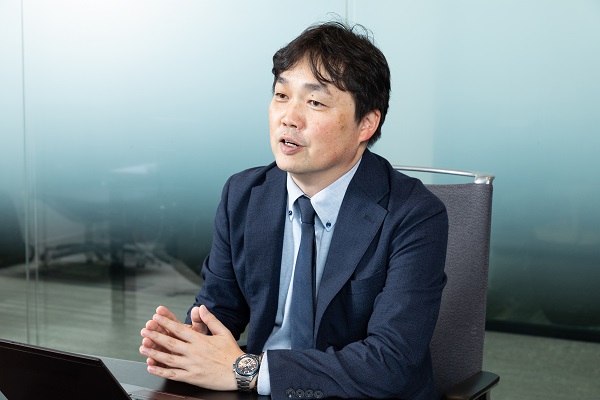
Q: What were you hoping to achieve in formulating disaster prevention audit standards for Kanesada?
Mr. Hatakeyama: After their second fire accident, Kanesada’s leadership team conveyed to us how determined they were to have no more accidents, which led us to propose formulating disaster prevention audit standards. I determined that what Kanesada needed most was a framework to systematically eliminate each risk factor that could potentially cause a fire accident.
There are three points that companies should be particularly aware of when formulating disaster prevention audit standards. First is to ensure all pertinent items are included. Fires can have a wide variety of causes, so only addressing some is not enough for prevention. It is important to establish an exhaustive list of items, taking into account their materiality and priority. Although Kanesada had already formulated countermeasures for the causes of their two fires, we introduced them to other potential fire accidents and their root causes, and proposed countermeasures based on our extensive experience in frontline investigations.
Second is to close the gap between standards and reality. No matter how lofty your standards are, they are meaningless if they cannot be implemented on the front lines. When creating rules, it is essential to partner with those on the front lines and identify which measures are truly actionable.
Third is to not stop at establishing standards, but regularly review and follow up on them. At the risk of stating the obvious, this is actually the most critical and the most challenging part. The year after establishing its standards, Kanesada conducted a review of countermeasure implementation together with TdR. We subsequently organized a Disaster Prevention Seminar aimed at enhancing their ability to independently identify challenges and improve disaster prevention. We also supported follow-up activities.
Preparedness is the foundation for sustained growth
Q: What should companies aim for in formulating disaster prevention measures?
Mr. Hatakeyama: When formulating disaster measures, I recommend that companies consider three questions: (1) What can be done to prevent fires from occurring? (2) What can be done to minimize damage if a fire does occur? And (3) what can be done to protect the lives of employees?
Within the manufacturing sector especially, quality and production efficiency can often take precedence over safety. However, once a fire breaks out, the very survival of the company is jeopardized. I firmly believe that for companies, maintaining a sound sense of urgency and thoroughly implementing measures to prevent accidents is the foundation underpinning sustainable growth.
Building a disaster-resilient society
For a holistic perspective, we asked Yusuke Hattori of the Corporate Planning Department’s Sustainability Office at Tokio Marine Holdings about TMNF’s future prospects for corporate disaster management support.
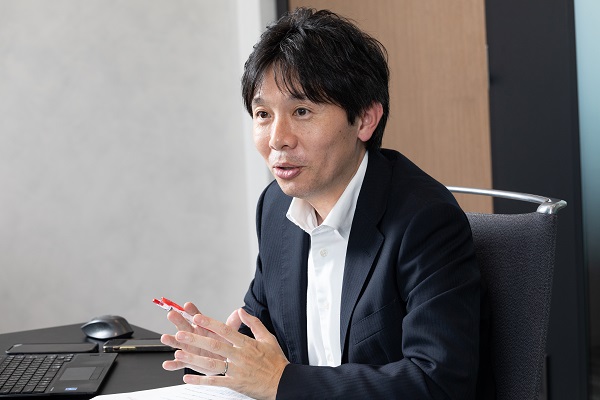
Mr. Hattori: From natural disasters to cyberattacks, every year we see greater damage from an increasing variety of risks. Tokio Marine Group has a long history of tackling such social challenges head-on, as part of our drive to build a more disaster-resilient society.
The fundamental role of an insurance company is to pay out insurance claims when customers suffer a disaster. Our aspirations, however, extend further. To enhance disaster preparedness, we visualize our customers’ risks and propose concrete countermeasures. In the event of a disaster, we not only assist with early recovery, but also provide post-disaster support to help build back better. Through such integrated services, we believe we can reduce the future damage our customers would otherwise suffer and minimize losses for society as a whole.
As the number of customers we serve continues to grow, we are committed to strengthening our initiatives and, as a company, to unite in helping build a more disaster-resilient society.
-
*1Established in 1996, TdR provides highly specialized risk solutions, from risk analysis and issue identification to solution proposals, including support for companies developing disaster prevention audit standards and business continuity plans.
-
*2BELFOR provides disaster recovery support worldwide for fires, floods, and other disasters.
-
*3Tokio Marine dR’s service to develop disaster prevention audit standards helps companies build their own disaster prevention evaluation standards based on insights gained from over 500 annual fire and disaster prevention surveys. Drawing on Tokio Marine Group’s unique perspective, TdR helps companies review and organize existing standards and reconstruct them into comprehensive, highly effective audit standards.