Report From the Risk Solution Frontlines: Safer Forestry in Gifu Prefecture
- Social Issues & Advancing Society
- Insurance & Risk Insights
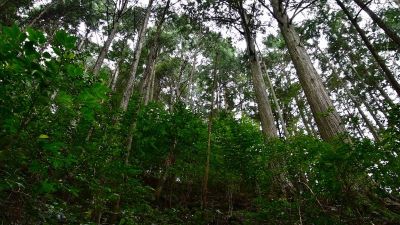
Despite how it may seem from the concrete jungles of our modern cities, forestry remains a key driver for regional economies and a critical industry for realizing a decarbonized society. In Japan, however, forestry is facing crippling labor shortages and a high rate of occupational accidents. At work sites in mountainous areas especially, work environments can vary tremendously from one job to the next, making it difficult to establish broad standards for workplace safety.
The Japanese prefecture of Gifu is known as a “forest prefecture,” with 81% forest density—the second highest in Japan. As such, it experiences firsthand the structural problems afflicting the industry.
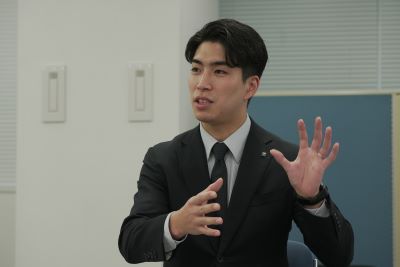
Chisato Yoneda and Yuudai Abe of Tokio Marine & Nichido Fire (TMNF) saw an opportunity to work with local stakeholders on reducing forestry risk. By applying their broader accident analysis expertise, they helped establish a safe forestry platform that is now being rolled out across the entirety of Gifu.
Facing unpredictable threats
For a long time, however, actual accident prevention measures were seen as the responsibility of individual cooperatives. Each organization would rely on their own ingenuity and experience to guarantee the safety of their staff. They kept their own data and records without broader coordination or prefecture-wide information sharing.
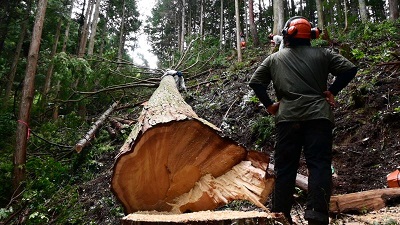
But they quickly hit a major obstacle. Unlike the controlled environments of manufacturing and retail, the risks of forestry vary from one job to the next, depending on the unique conditions of the trees, terrain, weather, and location. Conventional accident prevention methods wouldn’t apply. They needed a way to assess the realities of how dangerous situations arose in the forestry industry, so rather than limit themselves to actual accidents, they turned their attention to near misses.
Defeatism versus data
The forest cooperatives had compiled data on 440 near miss cases over the course of several years. While they were proactive in information collection, the data wasn’t translating into new accident prevention measures. Danger in forestry had become such a given that measures to prevent recurrence were often limited to: “We’ll be more careful in the future.” Details on how they would be more careful were lacking.
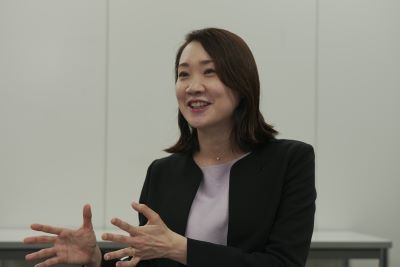
At first, participants were skeptical. They believed accidents were part of the job, and therefore the “5 Whys” analysis framework was a poor fit for forestry. In response, she framed her perspective in the context of her insurance expertise. Her approach was novel to the forestry professionals in the way it offered an analysis from multiple angles—not only human error, but also systemic issues like facilities, the broader environment, and management systems.
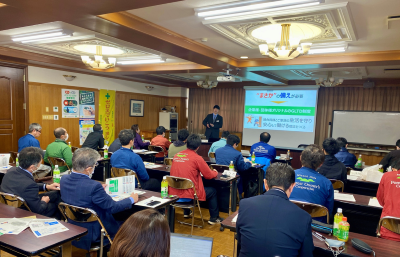
By the end of the safety conference, participants warmed to her approach and agreed to take the next step: transforming the data into a usable framework.
Building consensus for a new safety platform
Given the positive response at the safety conference, Yohei and Chisato went before the Gifu Prefectural Department of Forestry Policy and the Gifu Federation of Forestry Cooperative Associations with a proposal: to transform the existing decentralized information landscape into a standardized platform for storing and analyzing data. The Prefecture and Federation agreed for all 19 cooperatives in Gifu to take part.
But despite clearing approvals and creating a useful platform, getting the cooperatives to adopt and use the tool was far from easy. Not all employees had the appropriate level of digital literacy. To increase uptake and improve the user experience, TMNF worked with the Federation to raise awareness. Through repeated explanation sessions and workshops, eventually, participation increased.
Before long, every cooperative in Gifu was reporting near miss incidents.
Sustainable forestry through “insurance +α”
While the safe forestry platform project is still in its early stages, the enthusiasm around adoption of the solution demonstrates the role insurance can play in society: not only paying claims and responding to the unexpected, but offering proactive solutions to reduce risk and prevent recurrence.
Contributing to the sustainability of Japanese forestry is an issue of particular importance to Tokio Marine. We are currently in the process of building our new headquarters: a 100m-tall structure in the Marunouchi district of Tokyo, made primarily of domestically sourced lumber. The building is expected to use the largest volume of wood of any building of its kind worldwide.