CFO Letter
Since assuming the role of CFO, I have focused on a fundamental question: where, when, and how much of the Group’s capital we should deploy to create the greatest value?
My guiding principle is clear: capital should not remain idle. Capital must provide financial resilience in periods of stress, but it is also a resource for creating value for customers and society and, in turn, driving profit growth. I therefore see my role as CFO as preserving financial strength while allocating capital to growth opportunities with discipline and ensuring that it is put to effective use.
We have combined profit growth in our insurance underwriting and asset management businesses with disciplined capital allocation to deliver top-tier EPS growth and steadily improve ROE.
This performance is underpinned by a positive cycle in which we generate capital through organic growth and portfolio optimization and then redeploy it into business investments and shareholder returns.
While Tokio Marine Group has made steady progress, our ROE continues to have significant potential for further improvement relative to global peers. At the same time, strong business performance and the sale of business-related equities have increased our capital headroom. As a result, we have received increasing questions from capital markets regarding the timing and priorities of our capital deployment.
I take these expectations seriously. However, growth must be pursued with discipline. Investing in businesses where we cannot fully leverage our strengths, or paying excessive prices for acquisitions, could undermine the medium- to long-term profit growth and ROE improvement we seek to achieve. Rigorous discipline in determining which risks to take, and which to limit, is therefore not a constraint on growth, but a prerequisite for sustainable value creation.
The foundation for these decisions is the ERM framework that we have continuously refined. As the business environment becomes more complex and the pace of change accelerates, we will further strengthen our ability to assess the risk-return profile of each business and investment opportunity with rigor, and to allocate capital with both agility and discipline. By enhancing this cycle of capital generation and capital allocation, we will drive sustainable profit growth and further improve capital efficiency.
Our partnership with Berkshire Hathaway is an important initiative supporting this evolution. Its substantial capital strength provides stable, long-term reinsurance capacity, helping us manage volatility arising from natural catastrophes and other risks. By reducing the capital required to prepare for contingencies, this arrangement expands our capacity to invest in growth opportunities. The partnership also broadens our strategic options, including for large-scale M&A, and further enhances the flexibility of our capital management.
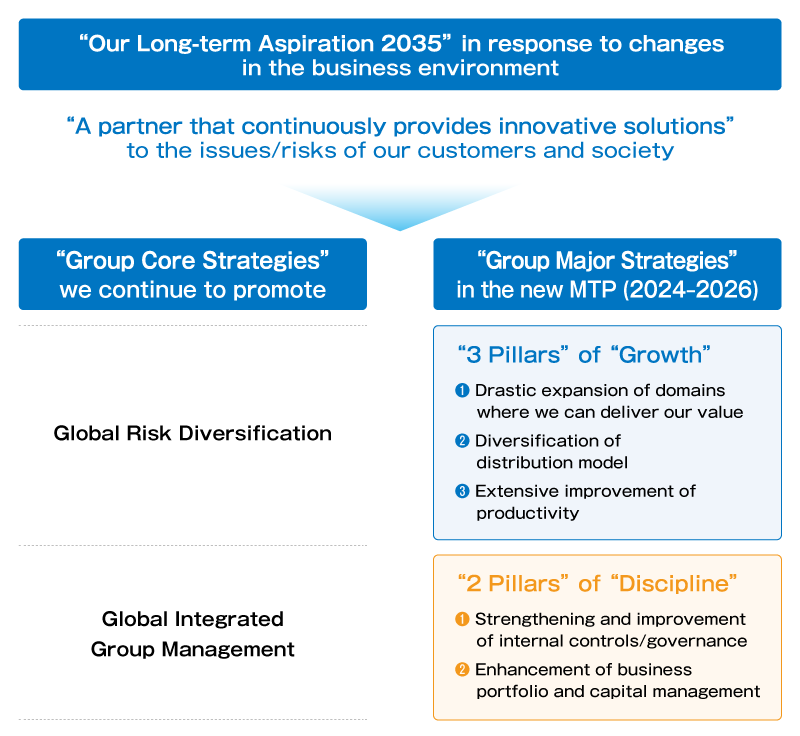
As CFO, I will lead these efforts. Through constructive and transparent dialogue with capital markets, I will incorporate the perspectives and expectations of our stakeholders into management decisions. In doing so, we will further strengthen our earnings capacity and advance toward the Aspiration 2035 targets of adjusted net income of at least ¥1.7 trillion and adjusted ROE of at least 17%.
Tokio Marine Groupʼs capital circulation cycle
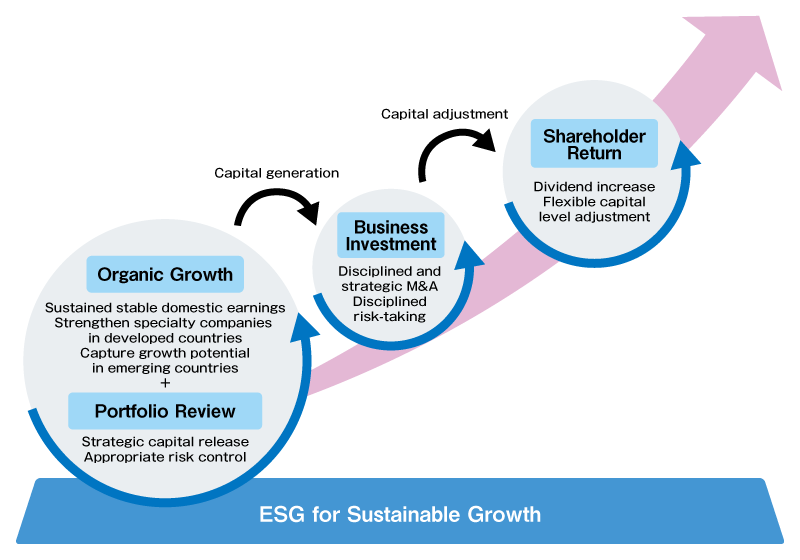
Sustaining top-tier EPS growth through organic growth, portfolio review, and business investment
Organic growth
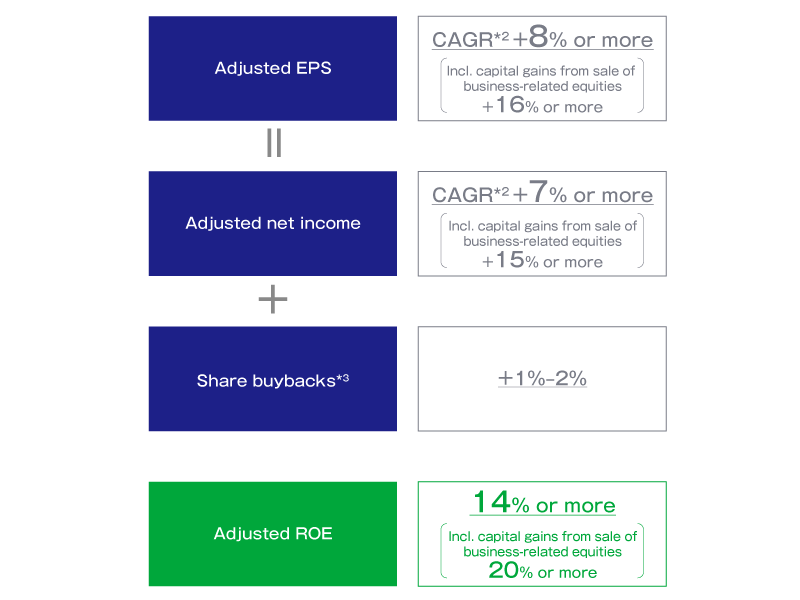
Our focus is not simply on capital reduction or balance-sheet contraction, but on improving ROE by growing profits and expanding our businesses. In fact, we have consistently generated stable profit growth in both insurance underwriting and asset management while managing volatility, achieving top-tier EPS growth comparable to, or even exceeding, that of our global peers. Under our current Mid-Term Business Plan (FY2024–FY2026), we target an EPS growth CAGR of 8% or more on a JGAAP basis and currently expect to deliver a CAGR of 12%, well above that target.
The driving force behind this growth is our well-diversified business portfolio, which enables us to capitalize on our competitive advantages in ways that reflect the characteristics of each market. In Japan, our strong distribution network and sophisticated underwriting capabilities generate earnings on a stable basis. In North America, our specialty expertise and disciplined underwriting enable us to achieve superior growth in the world’s largest insurance market. In emerging markets such as Brazil and Asia, we are capturing market growth and enhancing profitability through the use of data and digital transformation. Meanwhile, our solutions business is expanding our ability to deliver safety and security solutions beyond insurance products. Together, these distinct growth drivers enable us to achieve sustained, strong profit growth.
Adjusted EPS (yen)
-
*1Excluding gains on the sale of business-related equities and changes from the initial forecast for natural catastrophes, capital gains/losses in North America, etc.
-
※Presented on a pre-15-for-1 stock split basis before the October 2026 stock split.
Portfolio review and business investment
Sustaining top-tier EPS growth requires not only organic growth but also continuous review of our business portfolio and the reallocation of capital to areas offering greater growth and return potential. We take a forward-looking approach to assessing each business’s growth prospects and risk-adjusted returns, its contribution to diversification across the Group, and whether Tokio Marine can be the best owner. Based on these assessments, we execute both “In” strategies (acquisitions and new business launches) and “Out” strategies (divestments and run-off).
For “In” strategies, we allocate capital with discipline to opportunities that offer a strong cultural fit and an attractive ROI. Valuations of potential targets for large-scale M&A remain high, requiring us to be patient in identifying the right opportunities. However, we are seeing a growing number of attractive opportunities for small and medium-sized bolt-on acquisitions that can strengthen the competitive advantages of our existing businesses. Recent examples include PHLY’s acquisition of Ignyte Insurance and TMHCC’s acquisition of Agrihedge, both investments that build on our existing strengths. In Canada, a market where we see strong long-term growth potential, we established a local operation through a greenfield investment in 2022 and achieved profitability in its fourth year of operation.
For “Out” strategies, we review businesses with limited prospects for future growth or where our strengths are unlikely to drive further value creation, considering options including divestment and run-off. Recently, in addition to selling our local subsidiary in Saudi Arabia, we completed the transfer of our reinsurance portfolio in South Korea and closed the business. These initiatives have generated capital and increased the amount available for future growth investments.
We support top-tier EPS growth by continuously strengthening our business portfolio through the twin engines of organic growth and our In/Out strategies.
In (acquisitions and new business launches) / Out (divestments and run-off) strategies
-
*2ROI is calculated using the simple sum of projected fiscal 2026 adjusted net income on an IFRS basis as the numerator and the simple sum of acquisition amounts as the denominator.
-
*3An agency within Tokio Marine Highland Group, a subsidiary of TMK, that handles construction insurance.
Raising ROE to Global Peer Levels
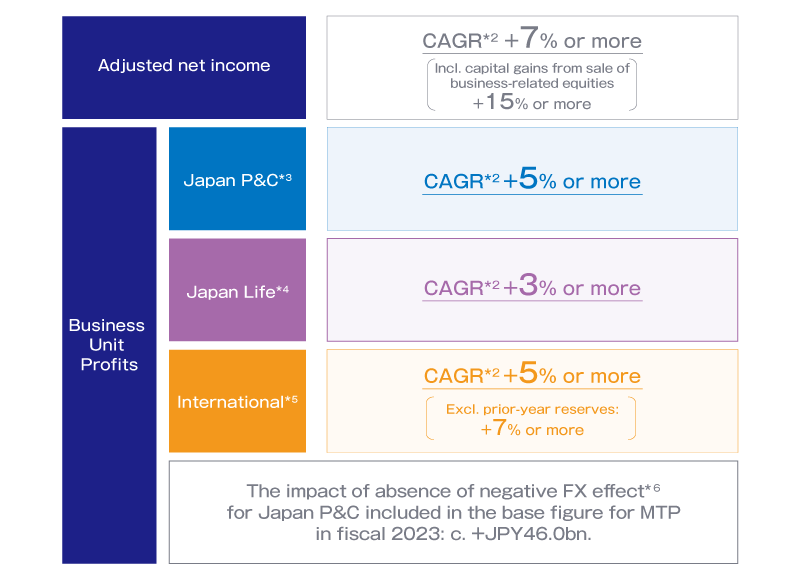
Alongside EPS growth, another important KPI to which we have committed publicly is raising ROE to the level of global peers. As of the end of fiscal 2025, our ROE on an IFRS basis was 12.9%, placing us among the highest levels in Japan’s financial sector. However, we recognize that there remains a gap between our ROE and that of global peers.
The foundation for improving ROE is top-tier EPS growth driven primarily by organic growth (① in the chart below). This is a strength we have consistently refined over the years and will remain the most important driver of ROE improvement. However, it is also something that global peers are striving to achieve. Therefore, to close the ROE gap with global peers, we must not only continue to grow profits but also steadily execute on the drivers specific to Tokio Marine for raising ROE.
Specifically, there are two key drivers. The first is the transformation of our business portfolio through the reduction of business-related equities (② in the chart below). By releasing approximately 0.6 trillion yen of risk tied up in business-related equities, we will create additional capital headroom that can be redeployed to our core businesses, where we expect higher returns on risk. This is an ROE enhancement opportunity largely unique to us.
The second is the expansion of our solutions business (③ in the chart below). By expanding our fee-based solutions beyond insurance, including risk consulting for disaster prevention and mitigation and support for rapid post-accident recovery, we will develop sources of earnings with relatively low capital requirements. The solutions business is an area we are only now beginning to expand in earnest, giving us another unique opportunity to improve ROE.
By fully leveraging these drivers, we will raise ROE to the level of our global peers.
Raising ROE to global peer levels*1
-
*1Tokio Marine’s ROE is adjusted ROE based on the new definition (IFRS). For peers, figures are actual ROE for 2025 as disclosed by each company as a KPI. (Source: Company disclosures)
Progress on Reducing Business-Related Equities and Business Portfolio Transformation
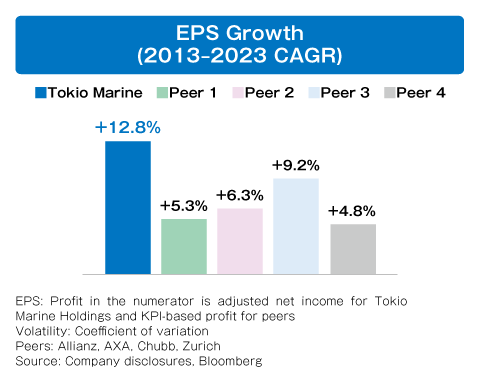
The steady execution of business-related equity sales underpins one of the drivers of ROE improvement: the transformation of the business portfolio. This initiative not only responds to capital market expectations for reducing business-related equities but also represents an important initiative aimed at optimizing our risk portfolio and improving capital efficiency.
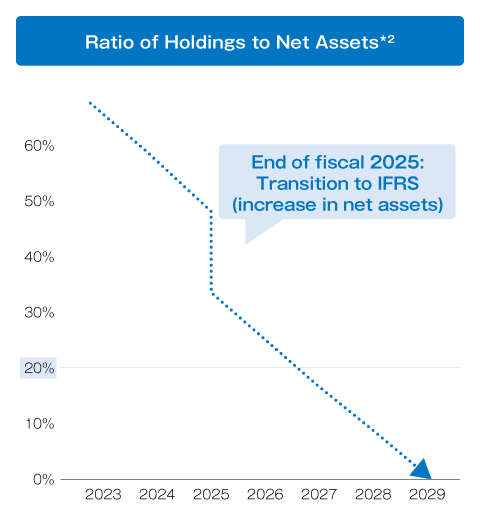
We have set a policy of reducing business-related equities to zero by the end of fiscal 2029, with an interim milestone of halving the balance over the three years of the current Mid-Term Business Plan. As in fiscal 2024, sales in fiscal 2025 exceeded the initial plan. Based on planned sales for fiscal 2026, we expect to reduce the balance beyond the halfway target set under the current Mid-Term Business Plan.
On the other hand, under our IFRS-based definition of adjusted ROE, capital gains/losses, including gains from the sale of business-related equities, are excluded from the numerator, while unrealized gains/losses are excluded from the denominator to enhance comparability with global peers. Consequently, gains from these sales do not increase the numerator of adjusted ROE, but are retained in the capital base included in the denominator. Furthermore, even when the capital and funds generated through these sales are deployed toward business investments, it takes time for them to translate into profit growth. Reducing business-related equities therefore acts as a drag on ROE in the short term. Nevertheless, we continue to reduce these holdings because we believe that redeploying the capital tied up in business-related equities to core businesses with higher expected ROR is essential to improving ROE over the medium to long term.
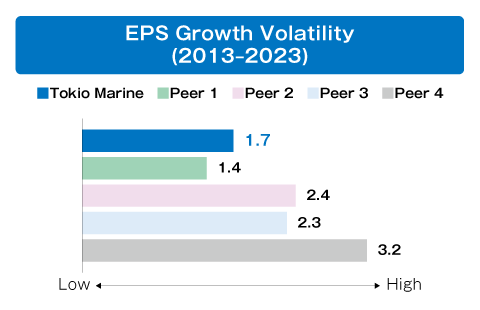
This effect becomes clearer when ROE is broken down into ROR and ESR. To improve ROE, it is important to raise ROR, which measures return relative to risk, while maintaining ESR at an appropriate level. The ROR on business-related equities is approximately 4.9%, substantially lower than the approximately 39.0% for our core businesses, making these holdings a drag on the Group’s overall ROR. Redeploying the risk capacity released through the reduction of business-related equities to core businesses with higher expected ROR will therefore contribute to improving ROE over the medium to long term.
Eliminating business-related equities will release risk equivalent to approximately 0.6 trillion yen , or around 21% of total risk*4. This represents a significant ROE improvement opportunity that is relatively unique to us. We will redeploy the resulting risk capacity toward selective risk-taking in our domestic and international insurance businesses, enhanced asset management, and expansion of the solutions business.
By shifting capital and risk capacity toward higher-return businesses, we will transform our business portfolio to deliver greater profitability and capital efficiency, thereby improving ROE over the medium to long term.
Sales of business-related equities
Reinvestment into higher-ROR businesses (Transformation of business portfolio)
-
*1Based on market value as of the end of March 2026.
-
*2Adjusted net assets are calculated as the average balance of net assets on an IFRS accounting basis, excluding unrealized gains/losses (AOCI), etc. In contrast, economic net assets represent the end-of-period balance on an economic value basis, with assets and liabilities measured at market value. As the definitions differ, figures on each side of the equation do not match.
-
*3After diversification and after tax.
-
*4As of March 31, 2026.
Shareholder Returns Under IFRS/ICS
DPS growth aligned with EPS growth
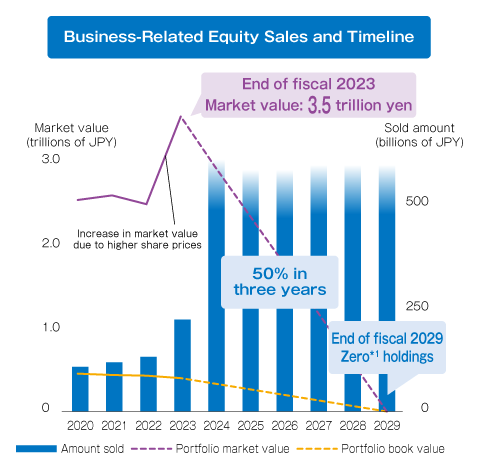
Dividend per share (DPS) remains the cornerstone of our shareholder return policy. Even after the adoption of IFRS, our policy of steadily increasing DPS in line with profit growth remains unchanged. Previously, we used the five-year average of adjusted net income as the basis for dividends. Following the adoption of IFRS, however, capital gains/losses, including gains from the sale of business-related equities, are excluded from IFRS adjusted net income, which is expected to reduce year-to-year volatility in earnings. We will therefore use the three-year average of IFRS adjusted net income as the basis for dividends, with a payout ratio of 50% as our guiding principle.
Fiscal 2026 is the first year in which our new dividend policy applies and a transitional year between the previous and new definition of adjusted net income. We have therefore based the dividend on the three-year average of IFRS adjusted net income, while also placing importance on continuity with our previous approach. Taking into account the dividend level implied by our previous policy, we have set DPS at 245 yen, up 27 yen year on year, marking the 15th consecutive annual increase.This represents DPS growth of approximately 12%.
We will continue to sustainably expand our dividend-paying capacity through profit growth in our core businesses and achieve DPS growth aligned with our top-tier EPS growth.
DPS growth
-
※Presented on a pre-15-for-1 stock split basis before the October 2026 stock split.
Flexible share buybacks
While dividends remain the cornerstone of our shareholder returns, we position share buybacks as a means of appropriately adjusting our capital level. For fiscal 2026, we have decided to conduct share buybacks totaling 400.0 billion yen. This decision takes into account a range of factors, including our ESR, which remains at a robust level of 268%, the greater flexibility in capital policy provided by our strategic partnership with Berkshire Hathaway, and the capital required for future growth investments.
The 287.4 billion yen share buyback announced on March 23, 2026, to offset the dilutive impact of the third-party allotment to Berkshire Hathaway is not included in the aforementioned 400.0 billion yen. As the share price has risen since the announcement, we expect that additional share buybacks will be necessary to fully offset the dilutive impact. Any such additional buybacks will be taken into account in determining shareholder returns for the second half of fiscal 2026.
For share buybacks from fiscal 2027 onward, we will consider them together with the business and capital strategies under our next Mid-Term Business Plan and announce our approach in May 2027. The amount of share buybacks in fiscal 2026 should not be viewed as a baseline for subsequent years. However, our approach remains unchanged: We will prioritize growth investments and, when there are insufficient investment opportunities that meet our disciplined criteria, adjust our capital level through share buybacks.
Economic Solvency Ratio (ESR)
-
*1Risk is calculated using 99.5% VaR.
-
*2ESR after reflecting the 400.0 billion yen share buyback and risk-taking under the business plan at 234%.
Enterprise Risk Management (ERM)
As an insurance company, we increase returns by taking risks in insurance underwriting and asset management as a key to our business. We have positioned Enterprise Risk Management (ERM) as the cornerstone of Group management. ERM takes into consideration our risk appetite, to what extent we undertake risks (risk boundaries), whether return on risk is sufficient, and whether risks are appropriately diversified. We have also established the ERM Committee to discuss ERM strategy. The committee assesses the growth potential and profitability of all businesses and the risks associated with each strategy in a forward-looking manner and formulates a capital allocation plan to optimize the risk portfolio from a Group-wide perspective. By doing so, we aim to achieve capital adequacy and high profitability relative to risk. This approach is intended to sustainably enhance our corporate value.