Green Seagrass, Blue Carbon, and an Ocean of Possibility for Stronger Economies and Ecosystems
- Sustainability
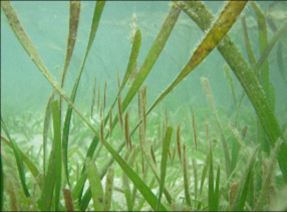
While carbon capture efforts tend to center around land-based projects like reforestation and mangrove planting, an important potential avenue for decarbonization lies beneath the waves. Tape seagrass (enhalus acoroides, known in Japanese as “umishobu”), native to the shallow coastal waters of Iriomote and Ishigaki islands in Japan’s Okinawa Prefecture, is a species recognized for its CO2 absorption properties. It is also disappearing, classified as Category II (Vulnerable) on the Japan Ministry of the Environment’s Red List of Threatened Species. The cause of the depletion is overgrazing by a population of green sea turtles that, due to a separate conservation effort, has grown large enough to threaten its own ecological collapse.
In response, Tokio Marine Asset Management (TMAM), in cooperation with local companies and communities, launched a project to restore the tape seagrass beds. In January 2026 tape seagrass was also awarded J-Blue Credit*1 certification, opening the potential for new value creation.
We interviewed Masayuki Okada of TMAM and Takeshi Oshiro and Yasuhisa Uezu of Okinawa Cellular Telephone Company (Okinawa Cellular) regarding to learn more about the project and its future outlook.
The value of tape seagrass conservation
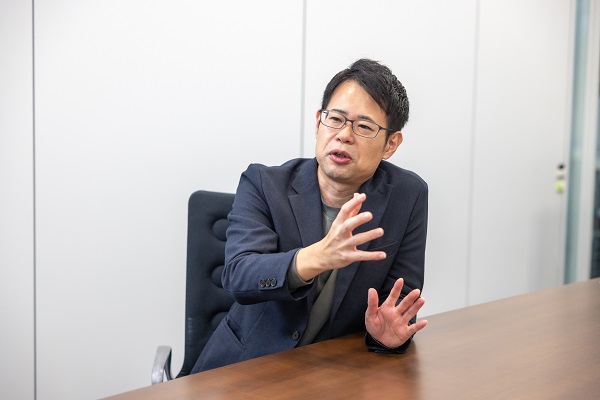
Masayuki Okada, ESG Specialist at TMAM who oversees the restoration project, was inspired to act when he heard the tape seagrass bed was deteriorating and called in for assistance.
“I saw that seagrass bed restoration aligned with our nature conservation policies, while also contributing to address environmental challenges through CO2 absorption,” he says. “I also believed we could commercialize this initiative by leveraging the expertise we cultivated through our core business of asset management and finance.”
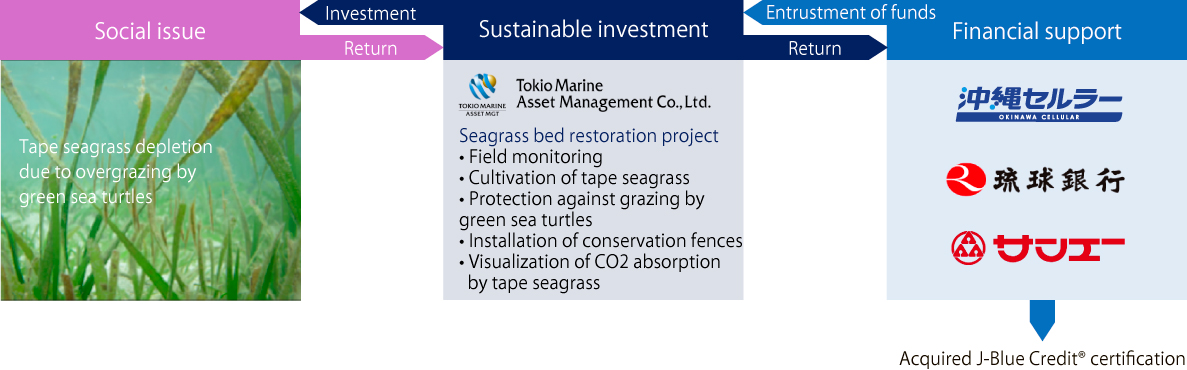
Methods of seagrass bed restoration and concept for business creation
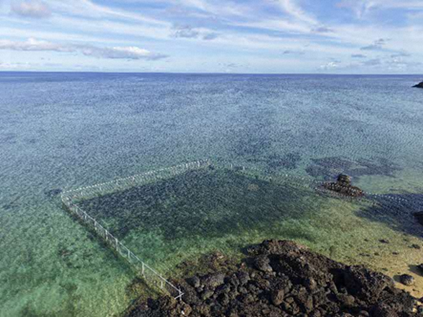
Meanwhile, companies based in Okinawa were invited to participate with an eye toward expanding the project.
Promoting social contributions from a CSR perspective as a good corporate citizen is important,” Okada went on to say, “But to expand it as a major initiative, a collaborative framework involving industry, government, academia, and the public was necessary. That’s why I devised a framework to visualize the CO2 absorption capacity of restored tape seagrass, which could then be translated into economic value for participating companies.”
One company that responded to the invitation was Okinawa Cellular, a local telecommunications provider. Mr. Uezu of Okinawa Cellular explained the background of his company’s participation in the project.
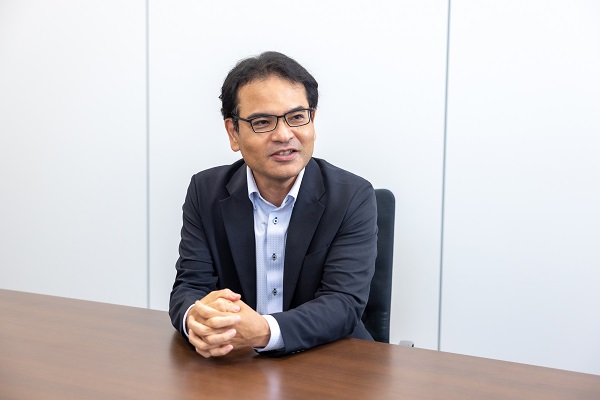
“Up to then, we had been engaged in coral conservation and tree planting, but these projects took about 10 years before results became apparent. In comparison, seagrass bed restoration produces results quickly, and is a compelling story of how communities and companies can work together to protect marine resources. Our company is from Okinawa, this is where we nurtured our business, and we are committed to the region’s continued development. Promoting carbon neutrality and nature positivity in Okinawa is a key issue for us. Through this project, we aim to lead and expand the movement for natural environment conservation throughout the prefecture.”
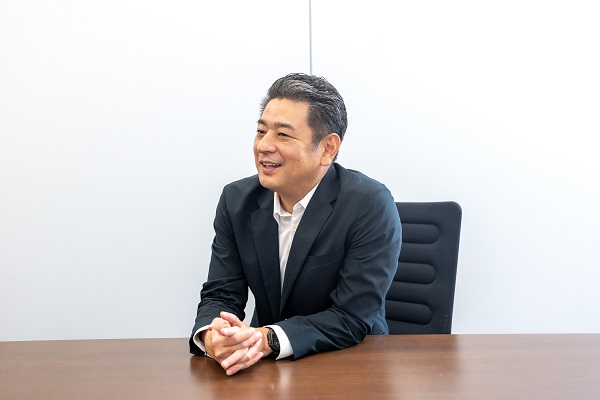
Compelling in both narrative and speed
About a year after the initiative began, Mr. Okada reported already seeing tangible results in the portion of restored seagrass. TMAM submitted an application with the Ministry of the Environment to designate the protected area as a “Nationally Certified Sustainably Managed Natural Site”*2. They prepared the application documents outlining the installation of protective measures, including site layout plans, as well as their activity plans, and the status of biodiversity conditions. Okinawa Cellular obtained consent for the application from the Prefecture. After review by a panel of experts and specialized committee, which included interviews of representatives from both companies, the Ministry of the Environment granted the certification—a first for the region.
J-Blue Credit certification and new business creation
Around the same time, given the CO2 absorption capacity of the tape seagrass, project partners also recognized the potential of applying for J-Blue Credit*3 certification. J-Blue Credit is a framework that awards credits for the CO2 absorbed by blue carbon ecosystems, such as seagrass beds, enabling their use in carbon offset trading and similar applications.
The certification process kicked off with awareness-raising initiatives aimed at recruiting partner companies. Okinawa Cellular reached out to companies within the prefecture to share project details and outcomes, while TMAM’s Okada spoke in multiple sessions about trends in domestic and international nature conservation activities and the potential for business creation through nature conservation.
“We started out with a lot of trial and error.” Mr. Oshiro recalled. “There was no track record for the certification of tape seagrass, and we also had no experience in creating J-Blue Credits. Therefore, we proceeded with research, monitoring, and application while consulting with the Japan Blue Economy Association (JBE), which manages and operates the J-Blue Credit system.”
The research first involved conducting a baseline study to determine the CO2 absorption capacity of the tape seagrass. Researchers looked for periods of stable weather to enter the ocean and conducted monitoring by diving and using drones to assess the CO2 absorption volume. Seagrass beds require continuous monitoring, since their annual absorption capacity fluctuates significantly. The cost in terms of personnel, money, and time was significant.
Ultimately, with cooperation from two additional companies, Bank of The Ryukyus, Limited and SAN-A CO., LTD., Okinawa Cellular was able to submit the application in August 2025. They achieved certification the following January.
Building a business platform that integrates each company’s expertise
The next step of the project will be to expand by leveraging Okinawa Cellular’s data communication technology and TMAM’s expertise in building business platforms.
Additionally, the MobaDAS*4 system developed by Nippon Koei Co., Ltd., a member of Tokio Marine Group, will allow to confirm the current and future growth potential of seagrass beds.
“Since seagrass bed restoration is also a nature-positive initiative with potential benefits for protecting rare species and restoring ecosystems, we are considering how to create value by visualizing these impacts over the medium to long term and utilizing biodiversity credits*5,” says Mr. Uezu.
Mr. Okada added, “We aim to broaden the circle of industry, government, academia, and citizens, harnessing the knowledge and technologies each possesses, to create a framework where more companies and local residents can participate. Our goal is for private-sector enterprises like ours to establish this socially valuable initiative as a viable business.”
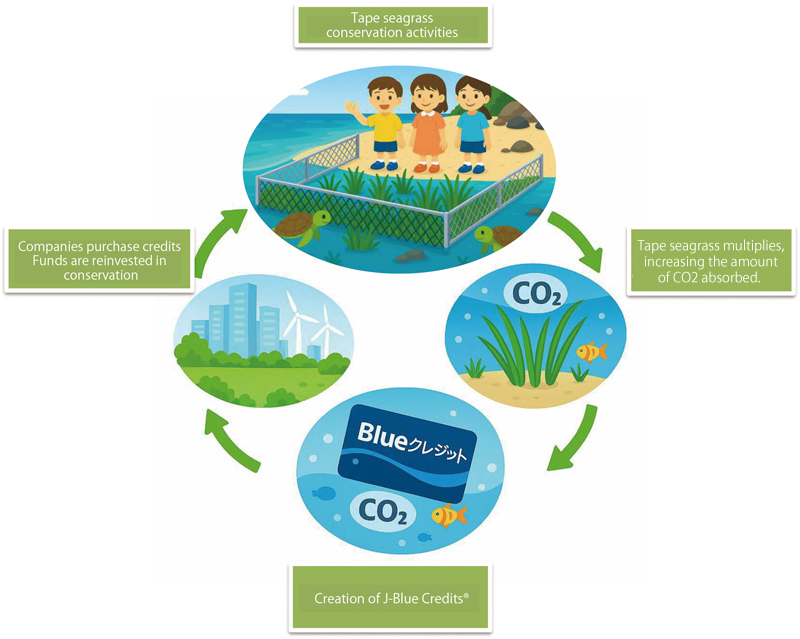
A precedent to be replicated nationwide
The J-Blue Credit market is expected continue adding on new carbon neutrality projects, while the Ministry of the Environment is studying how to implement biodiversity credits*5. It already held a “Study Group on the Valuation of Biodiversity” in 2025 and is in the process of developing rules and pilot projects.
At the same time, by combining the power of networks, technology, and finance, project stakeholders are committed to expanding this Okinawan seagrass bed restoration project across the whole of Japan.
-
*The information here is current as of the December 2025 interview.
-
*1J-Blue Credits(R) are unique credits verified, issued, and managed by the Japan Blue Economy Association (JBE) following a process of screening and consideration by a third-party committee which is independent of JBE.
-
*2Nationally Certified Sustainably Managed Natural Sites:https://policies.env.go.jp/nature/biodiversity/30by30alliance/documents/nintei/R6first69.pdf
-
*3Press release related to certification:https://okinawa-cellular.jp/common/uploads/0825.pdf
-
*4Nippon Koei’s MobaDAS:https://www.id-and-e-hd.co.jp/performance/mobadas/
-
*5Biodiversity credits Source: Ministry of the Environment, “Trends in Japan and Overseas Regarding the Valuation of Biodiversity”
-
*Reference links only available in Japanese