CEO Letter
As of June 2025, I’ve taken on the role of Group Chief Executive Officer (CEO). Stepping into this position at a company as storied as Tokio Marine Group, an industry leader since our founding in 1879, fills me with a deep sense of responsibility—and I’m ready to put everything I have into fulfilling that call.
For the 31 years since I took my first position here, I’ve worked in Japan and the United States, building experience in everything from underwriting and marketing in the field to corporate strategy at headquarters. My experience has deepened my appreciation for insurance—its ability to reduce uncertainty, support new initiatives, and bring happiness to customers. I also love being part of a company that not only engages in the insurance business, which plays a pivotal role in society, but also brings together such a diverse group of people under a shared mission: to be there for our customers and society in their times of need. That spirit runs deep throughout Tokio Marine Group.
Last December, my predecessor, Satoru Komiya, reached out to ask if I’d step into the CEO role. I was taken aback at first, but as we spoke, I knew I was ready to lead from the front, to help guide the Group forward through the next phase of our transformation and growth.
Since then, I’ve been asking myself the same questions again and again: What makes us strong? Where do we stand today? And what must we—myself included—do to drive even greater growth?
Tokio Marine Group: A long lineage of growth and improvement
Every company that aims for sustainable growth needs a competitive edge—unique strengths, in other words. So what exactly sets Tokio Marine Group apart?
In my view, there have been several “phases” in our history. What I call “Phase 1” lasted until around 2000. To that point, we focused on supporting the growth of our
customers and communities as Japan’s leading insurer in the non-life insurance industry. Then came “Phase 2.” The new millennium saw us make bold acquisitions, concentrating primarily on Europe and North America, and also build our own platforms with diligent care in Latin America and Asia. It was a time of overseas expansion, with a variety of approaches shaping progress.
That effort united colleagues, spanning the globe, who bring strong expertise and shared values to the table. Out of Phase 2 came a sense of both togetherness and mutual challenge, forming the vibrant foundation of what we call global integrated group management. It’s a core strength unique to Tokio Marine that improves the quality and precision of management decisions across every part of our business, both in Japan and abroad. Over the course of our history, we’ve grown into a Japan-born global company with a market capitalization of over 11 trillion yen, operations in more than 50 countries and territories, and a team of over 50,000 working alongside a great number of agents and brokers to be there for countless customers worldwide in their times of need.
Looking back, our business structure during Phase 1 left us highly exposed to the impact of the natural disasters that occur in Japan. We addressed those issues in Phase 2, as we actively expanded overseas from the year 2000 on to diversify our risks across both geographical borders and lines of business.
That same year, we launched our own reinsurance business, Tokio Millennium Re (TMR). In the years that followed, we executed a series of acquisitions in Europe and North America: Kiln, a long-respected name in the Lloyd’s market; Philadelphia, a firm with tremendous support in numerous niche markets; Delphi, with its excellent asset-management capabilities; HCC, a force in specialty insurance; and PURE, which specializes in high-net-worth insurance. These moves substantially expanded our insurance portfolio and further dispersed risk across the Group.
A big change came in 2019, when Tokio Marine made the move to sell TMR. As the forerunner of our push overseas, TMR not only helped us hone the skills we needed to manage insurance companies abroad but also provided a beachhead for our large-scale acquisitions in the West. Thanks to TMR, we were able to create an overseas business portfolio with a focus on primary insurance.
Reinsurance inevitably brings with it relatively high volatility, however, and our leadership made the strategic, proactive decision to divest TMR in 2018 to a more optimal owner. Given how TMR had consistently generated solid profits ever since its founding, there was certainly a part of me that thought, “We don’t have to sell it now.” I was also TMR’s chief operating officer at the time, having assumed the post in New York in 2014. I remember all too well how much of a challenge it was to communicate with our 200-strong team once the decision to divest had been made.
The experience of divesting TMR—feeling the weight and difficulty of a major strategic decision firsthand—has stayed with me. It’s a reminder of something that I’ve always tried to abide by: never let past success stand in the way of continuously diversifying our business model and transforming it as necessary.
Through our disciplined, carefully considered merger and acquisition (M&A) strategy, we’ve spent years and years crafting a well-diversified business portfolio where operations in Japan and overseas complement each other.
Backed by these two strengths—global integrated group management and global risk diversification—our recent financial results have stayed strong.
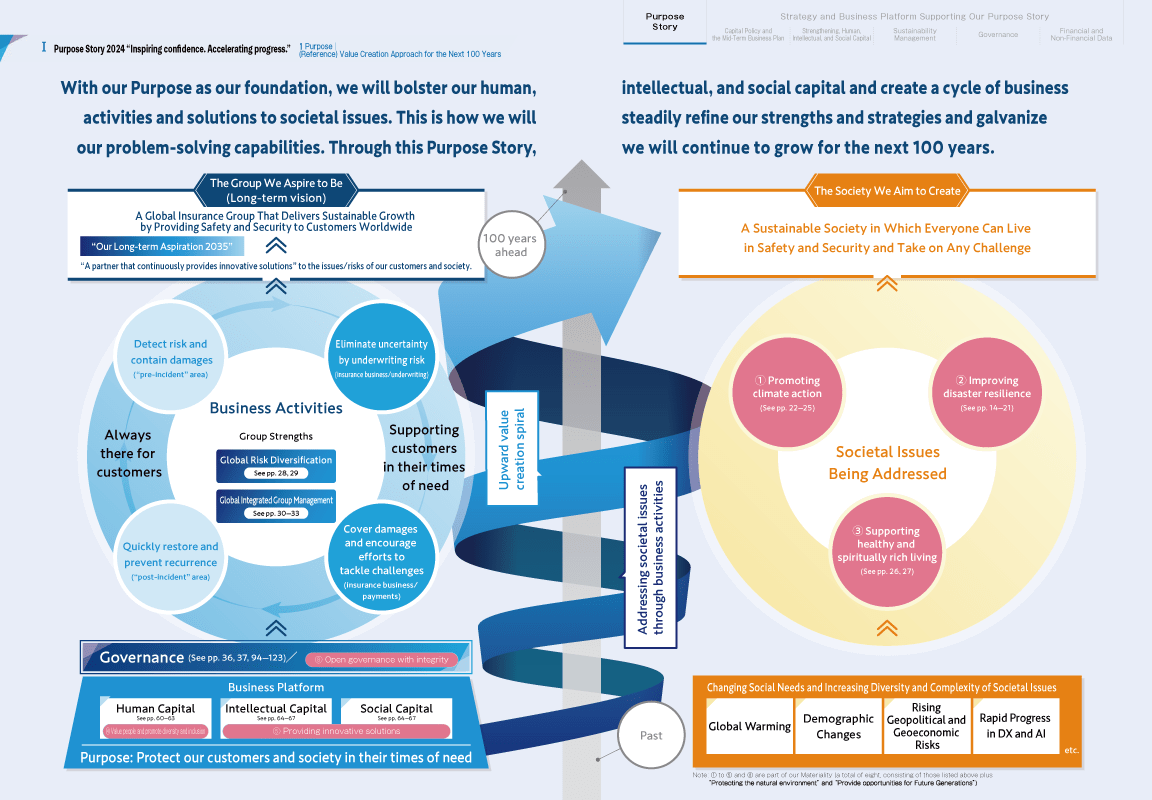
Transition of overseas business over 20 years
-
*Share of overseas business profit in the Group’s adjusted net income (excluding gains from sales of business-related equities in 2024)
Where we stand now
How did we fare in fiscal 2024? Despite a business environment teeming with uncertainty, from the geopolitical risks in Ukraine and the Middle East to shifts in policies and priorities in the US, our adjusted net income in fiscal 2024 reached 1.2 trillion yen.
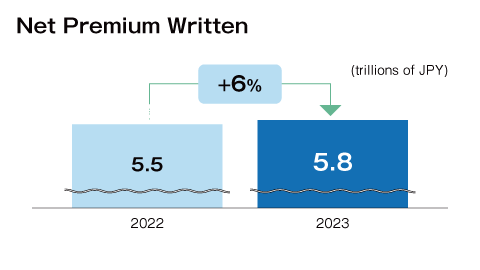
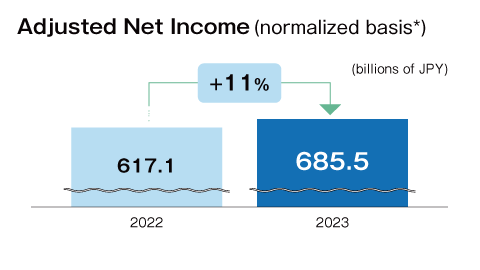
Those figures do include accelerating capital gains from the sale of business-related equities, providing a favorable tailwind. Even so, our adjusted net income excluding those capital gains, driven mainly by solid underwriting profits in the United States and Brazil, climbed 6% year on year to a strong 608.9 billion yen. Our net premiums written—the equivalent of sales at a general business—also grew steadily by 10% to 5.3 trillion yen.
In fiscal 2025, we’re projecting our adjusted net income excluding capital gains from the sale of business-related equities to grow 15% year on year to 700.0 billion yen. That forecast shows that our capabilities are steadily improving and that our Group framework is becoming more resilient.
FY2024 performance
-
*A management accounting profit indicator aimed at enhancing transparency and comparability from the market’s perspective, which is also used as a basis for shareholder returns.
How Tokio Marine needs to evolve in Phase 3
To me, our recent financial results make it clear that the two strengths at our foundation will enable us to sustain growth for the time being.
However, the business and social environments we operate in are rife with volatility, uncertainty, complexity, and ambiguity (VUCA) and changing at extraordinary, unprecedented speeds. Intensifying natural disasters, growing geopolitical instability, and accelerating advances in artificial intelligence (AI) are just some of the contributors.
Unless Tokio Marine actively adapts and evolves in response to those changes, our growth could stall as the strengths and advantages we pride ourselves on dissipate. That possibility creates a strong sense of urgency, encouraging as our recent results may be.
Being in a period of steady growth at the moment is exactly why we need to further the global evolution of our Group now while not losing sight of our Japanese roots. This is the time to start exploring Phase 3 for Tokio Marine. So what does that evolution look like?
The first component is a major transformation in our domestic business.
Since our founding in 1879, we’ve provided insurance to be there for our customers and society in their times of need and have been committed to solving the emerging social issues of each era.
In Phase 1, the insurance industry embraced the mission to make non-life insurance products available across Japan as a vital component of social infrastructure. Those efforts accelerated insurance sales nationwide. Alongside those successes, however, came practices that, in hindsight, were misguided—competing with industry peers in areas beyond where the true value of insurance lies, including the holding of business-related equities and excessive cooperation in customers’ businesses. These industry customs have lingered for years.
We at Tokio Marine have taken a hard, honest look at this history. Recognizing the need for better approaches, we’re now pursuing our Re-New initiatives to overhaul and transform to more thoroughly deliver on our promise of being a deeply trustworthy, customer-oriented company.
As part of those efforts, we’re strengthening our long-standing capabilities—underwriting expertise (the ability to make judgments about taking on risks) and claim-handling responsiveness—along with our consulting expertise to help mitigate losses from natural disasters and other risks.
Working to accurately identify the risks and challenges facing customers and society, we’re determined to deliver the optimal insurance and services to meet the relevant needs. That, we know, is the true value of insurance.
Instead of selling insurance products for their own sake, we’re fostering a sound organizational culture that propels a cycle of tackling social issues head-on and taking action to forge solutions—all with a focus on putting the customer first. By embracing that cultural transformation, we aim to maintain our identity as a company that is chosen by customers and society.
As we strive to provide the value at the heart of what insurance is, I know that the real source of our competitive edge is the expertise each employee brings to the table—the power of our people. That’s why we’re more determined than ever to invest in bolstering our human capital.
Second is the expansion of our overseas business.
First, we’ll keep expanding our operations in North America, which account for roughly 80% of our overseas profit and deliver top-tier growth among regional peers—but our market share within the region itself is still only in the low two-percent range. As the world’s largest market, with its massive spending power and continued growth prospects, North America offers us ample opportunity to expand further.
Our approach to expanding will involve organic growth through our overseas subsidiaries, of course, and M&As. Since our 2020 acquisition of PURE, however, attractive opportunities have been relatively few and far between due to soaring valuations and other factors. We are taking a patient watch-and-wait approach. Insurance premium rates, which often correlate with insurer valuations to a certain degree, have softened in a downward general trend in some lines, and the number of opportunities for small to medium-sized bolt-on M&As that could complement our existing operations is on the rise. We’re keeping a close, eager eye on the potential for these opportunities, which could eventually lead to large-scale M&A prospects.
Working with colleagues who share our aspiration for further growth in North America, we keep our M&A target list up to date and are constantly evaluating potential acquisition candidates. When we believe the timing is right, we’ll make our move.
North America isn’t our only focus area, though. In other sizable markets with high growth potential—Brazil and Thailand, for example—our “pillar” businesses have taken solid shape, piece by piece, over time. In emerging markets as a whole, we’ve posted double-digit profit growth over the past five years.
We’ll continue pushing expansion in regions with strong growth prospects. When the right opportunities arise, we’ll also explore the possibility of M&As in advanced and emerging economies outside North America, keeping geographic risk diversification in mind.
The third and final part of our evolution is pushing beyond insurance and venturing into new solutions businesses.
The world is full of risk. The scale of economic losses continues to grow across the globe. That means our core business—insurance for confronting those risks—will obviously remain a growth industry for years to come.
But there are also compelling growth opportunities in initiatives and areas looking to reduce losses that insurance can’t cover. By supporting customers and society on that front, too, we can offer value in new ways
When I was leading the Corporate Planning Department at headquarters, we discussed those domains extensively and laid the groundwork for establishing a solid business presence for us there. Those plans took firmer shape this year with Integrated Design & Engineering Holdings (ID&E)—with subsidiaries including Nippon Koei, Japan’s top engineering consultancy—joining the Tokio Marine Group.
Combining Tokio Marine & Nichido’s plethora of risk information and claims payment data with ID&E’s advanced engineering expertise, an asset that sets us apart from every other non-life insurer in Japan, we’ll now be able to provide disaster prevention and mitigation solutions that help avoid loss in the first place and offer effective measures for preventing recurrence.
If we can stabilize our property insurance performance by making customers’ homes, factories, and other assets more resilient, we’ll be able to lower customer premiums—and, more importantly, provide insurance to a broader range of customers sustainably. And if our “insurance + solutions” approach helps build a society better able to withstand disasters, the trust customers place in us will grow even deeper.
Bolstering resilience across society will also reshape our business model and profit. If we can reduce capital load by diversifying our business base and develop a solutions business centered on fee income into a revenue pillar, that will help enhance our return on equity (ROE) as well.
“Sustainability the Tokio Marine way,” powered by our people
What I want to emphasize here is that our domestic transformation, our overseas expansion, and our push into the solutions business all start with the approximately 50,000 employees who make up our Group. Every one of our people remain true to our Purpose: to be there for our customers and society in their times of need. That drive and passion ripple outward to our agents, brokers, and other partners, giving our collaborative relationships a deeper, richer dimension. Employees and partners work together to deliver high-quality services, help create solutions to customer challenges, and cultivate local communities, enabling us to generate profits that we then return to our shareholders. While we carry this business model forward, we’re also determined to keep it evolving into the future.
At the source of everything are our people, the core foundation that we work from to make happiness for all stakeholders a reality. For us, this has always been—and will always remain—how Tokio Marine creates value.
By endeavoring to enhance the sustainability of our customers’ businesses through solving social issues, we contribute to the sustainability of our group’s business model as well. This is the essence of “Sustainability the Tokio Marine way,” the spirit of our purpose to be there for our customers and society in their times of need, and the reason we exist as a company.
What I value — and my promise to our employees
When I became CEO, I shared a message with all our employees—my promise to them—and laid out what we should all prioritize in order to realize our evolution into Phase 3. I’d like to share that with you as well.
First is integrity. To me, integrity manifests in both your actions and your state of mind. It means being beyond reproach, acting with dignity, and always doing the right thing, even when no one is watching and delivering on Tokio Marine’s commitment. Providing safety and security through our insurance and solutions has an immense social significance—and comes with immense social responsibility. It’s a cause worth working for. At a fundamental level, insurance is a “People’s Business.” Trust from our customers hinges on our unwavering integrity.
Second is a strong sense of ownership and accountability. These concepts boil down to taking responsibility and owning our roles. To continue to evolve in the VUCA environment we live and work in, we need each and every employee to be independent, stay proactive, own their duties as professionals, and take that responsibility all the way through to delivering target outcomes.
If we put everything we have into the effort, understanding that each and every one of us is a starting point for action, our Phase 3 evolution is bound to succeed and take us to new heights. I’ll continue to lead our transformation from the front, always taking on challenges with integrity, ownership, and accountability at heart.
In Closing
Let me again express my sincerest gratitude: Our ability to do business rests on the support we receive from our shareholders and all our other stakeholders.
Our management strategy and overall direction for the future remain unchanged. By executing that strategy steadily and propelling the evolutions I’ve outlined, we’ll continue to deliver world-class earnings per share (EPS) growth and raise our ROE to levels on par with our global peers.
I’m fully aware of what people expect of me in my role as CEO: to make our path toward progress even more certain and maintain the pace of transformation—or accelerate it, as the situation demands—as we pursue material changes at Tokio Marine & Nichido and other reforms currently underway.
My predecessor, Satoru Komiya, often said, “With the exception of our founding purpose, there is nothing that we cannot change.” I’ve always felt the same way. As we embrace the legacy of success and organizational wisdom we’ve built and expand on what we do well, we’re eager to adapt and execute strategies to enhance corporate value in line with changing business conditions and flexibly adjust our structures as necessary.
Always working to better enhance and progress our unique model of global integrated group management, we’ll continue to evolve our Group while still embracing our Japanese roots and keep elevating our corporate value in a sustainable way.
I look forward to your continued support.
Information